



STAR Interview Answer Analyzer
Paste your draft answer below into the four sections. The tool will analyze the length and distribution of your story to ensure it follows best practices (Situation ~15%, Task ~10%, Action ~60%, Result ~15%).
0 words
0 words
0 words
0 words
Analysis Report
--
Enter text to analyze
- Total Word Count: 0
- Estimated Time: 0 seconds
- Active Verbs Detected: 0
Feedback & Recommendations
You’ve spent months studying policy frameworks, memorizing constitutional articles, and perfecting your essay writing. You pass the written exam with flying colors. Then comes the interview panel. The room is silent. One examiner leans forward and asks, "Tell us about a time you had to make a difficult decision under pressure." Your mind goes blank. You know the right answer exists in your experience, but how do you structure it so it sounds professional, relevant, and convincing? This is where most candidates stumble-not because they lack experience, but because they lack a framework to present it.
This is exactly what the STAR method is designed to solve. It’s not just a trick; it’s the standard communication protocol used by civil service boards, HR departments, and hiring managers worldwide to evaluate competence through past behavior.
Key Takeaways
- The STAR method stands for Situation, Task, Action, Result-a structured way to answer behavioral interview questions.
- Government job interviews rely heavily on behavioral questions to predict future performance based on past actions.
- Candidates must focus 70% of their response on the "Action" phase to demonstrate personal contribution.
- Preparation involves identifying core competencies (like leadership or conflict resolution) and mapping specific stories to each.
- Avoid common pitfalls like being vague, taking credit for team efforts without clarifying your role, or forgetting the result.
Why Behavioral Questions Dominate Government Interviews
To understand why the STAR method matters, you first need to understand what interviewers are looking for. In private sector tech startups, they might ask technical coding problems on a whiteboard. In government roles-whether it’s a junior clerk position or a senior administrative service role-the stakes are different. They aren’t just testing if you can do the job; they’re testing if you have the temperament, integrity, and decision-making skills to serve the public interest.
This is called competency-based interviewing. The underlying psychological principle is simple: past behavior is the best predictor of future behavior. If you handled a crisis well in your previous role, you’re likely to handle it well in this one. If you struggled with teamwork before, you probably will again.
Examiners use these questions to map your experiences against predefined competency frameworks. For example, the UK Civil Service uses nine core behaviors, including "Managing a Quality Service" and "Delivering at Pace." Indian UPSC interviews assess traits like "clarity of thought" and "integrity." Regardless of the country, the mechanism is the same: they want evidence, not opinions.
If you answer vaguely-"I’m a good leader"-you provide no evidence. If you use the STAR method, you provide a case study of your own life that proves the claim.
Decoding the STAR Framework
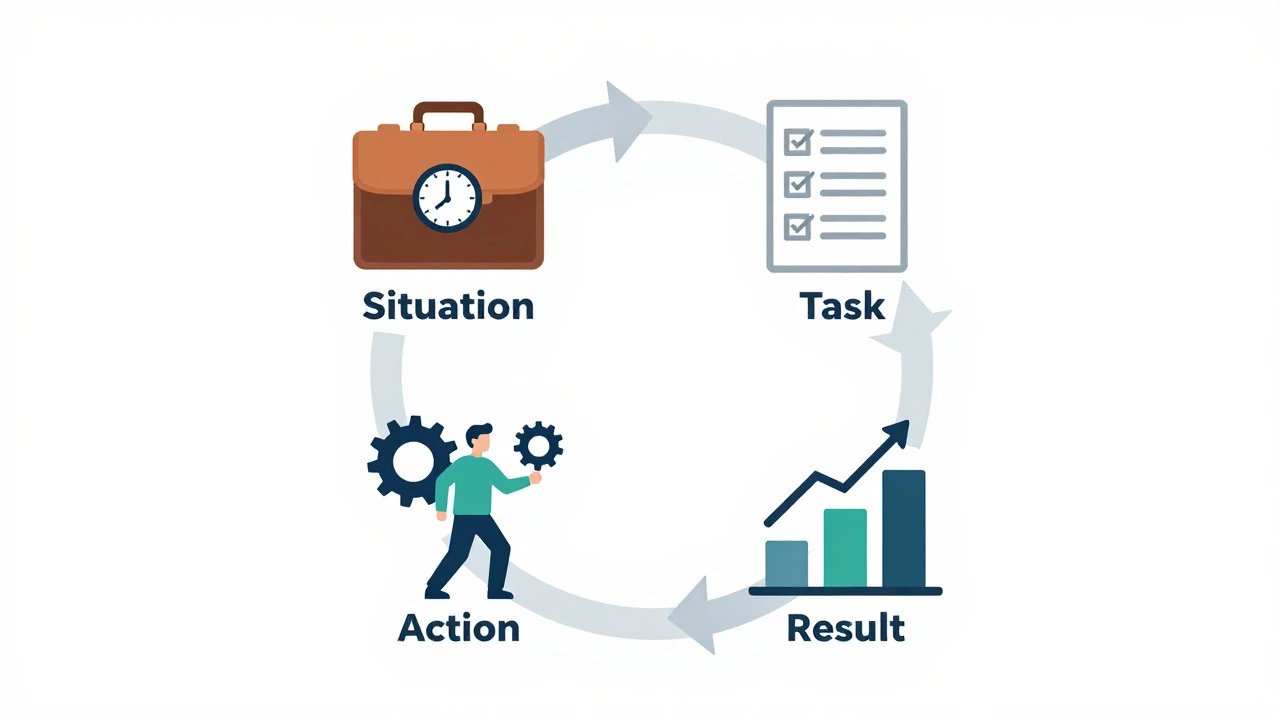
The acronym STAR breaks down any complex story into four manageable components. Let’s look at each part closely, specifically tailored for government and public sector contexts.
Situation: Set the Scene Briefly
The "Situation" provides context. Who was involved? What was the environment? Was there a deadline? A budget constraint? A political sensitivity? Keep this section short-about 10-15% of your total answer. Too much background bores the panel; too little leaves them confused. Focus on facts that highlight the difficulty or importance of the scenario.
- Good: "During my internship at the local council, we faced a sudden budget cut of 15% two weeks before the annual community festival planning meeting."
- Bad: "I worked at the council for six months doing various tasks."
Task: Define Your Responsibility
Next, clarify what needed to be done. This isn’t just about the team’s goal; it’s about your specific responsibility. Did you lead the project? Were you assigned to resolve a specific conflict? Did you have to analyze data under tight constraints? This step distinguishes your individual contribution from group effort. In government roles, clarity of accountability is crucial.
Action: The Core of Your Answer
This is the most critical part. Spend 60-70% of your time here. Describe the steps you took. Use active verbs: I analyzed, I negotiated, I implemented, I coordinated. Avoid saying "we" unless necessary, and even then, immediately follow up with what you did within that "we." Panelists want to know how you think, not just who you worked with. Explain your reasoning. Why did you choose that approach? How did you prioritize competing interests?
Result: Quantify the Outcome
Finally, share the outcome. What changed because of your actions? Did you save money? Improve efficiency? Resolve a complaint? Learn a valuable lesson? Whenever possible, use numbers. "Reduced processing time by 20%" is far more powerful than "made things faster." If the result wasn’t entirely positive, frame it as a learning opportunity-showing humility and growth mindset, which are highly valued in public service.
How to Prepare STAR Stories for Government Roles
You can’t memorize answers to every possible question, but you can prepare a library of versatile stories. Here’s how to build that library effectively.
Step 1: Identify Key Competencies
Look at the job description. What skills are emphasized? Common ones include:
- Leadership and Initiative
- Problem Solving
- Communication and Negotiation
- Teamwork and Collaboration
- Integrity and Ethics
- Adaptability
Create a spreadsheet with these competencies as rows.
Step 2: Brainstorm Relevant Experiences
For each competency, list 2-3 real-life examples from your work, volunteer activities, academic projects, or even significant extracurriculars. Don’t worry if an event seems small. Leading a student committee to organize a charity drive demonstrates coordination and resourcefulness just as well as managing a corporate project.
Step 3: Draft and Refine Using STAR
Write out each story using the STAR format. Keep it concise-aim for 90-120 seconds when spoken aloud. Record yourself. Listen for filler words ("um," "like") and vagueness. Ask a friend to listen and see if they can clearly identify your role and the impact.
Step 4: Practice Flexibility
A single strong story can often address multiple competencies. For instance, a story about resolving a team conflict might also demonstrate communication skills and emotional intelligence. Be ready to pivot your emphasis depending on the question asked.
Real-World Examples: From Vague to Impactful
Let’s transform a weak answer into a compelling STAR response suitable for a government administration role.
| Component | Weak Response | Strong STAR Response |
|---|---|---|
| Question | "Describe a time you dealt with a difficult stakeholder." | |
| Situation | "A client was unhappy with our service." | "While working as a case officer, a resident repeatedly complained about delayed waste collection in his neighborhood, threatening to escalate to the media." |
| Task | "I had to fix it." | "My task was to de-escalate the situation, investigate the root cause of the delay, and restore trust without exceeding departmental protocols." |
| Action | "I talked to him and fixed the problem." | "I scheduled a face-to-face meeting to listen actively. I discovered the issue was a routing error by the contractor. I coordinated with logistics to prioritize his street for the next run and provided him with direct contact details for future issues." |
| Result | "He stopped complaining." | "The resident withdrew his media threat. Collection resumed normally within 48 hours. Later, I proposed a digital tracking system for residents, reducing similar complaints by 30% over the next quarter." |
Notice the difference? The strong version provides specific context, clear personal action, and measurable results. It shows empathy, procedural knowledge, and initiative-all key traits for public servants.

Common Mistakes to Avoid
Even experienced candidates fall into traps during high-pressure interviews. Watch out for these:
- Being too brief: Some candidates treat STAR like a checklist and give one-sentence answers. Expand on your reasoning in the "Action" phase.
- Taking all the credit: Government work is collaborative. Acknowledge team support, but clearly delineate your unique contributions.
- Focusing only on success: If you failed, admit it honestly. Explain what you learned and how you applied that lesson later. Integrity matters more than perfection.
- Using hypotheticals: Never say, "If I were in that situation, I would..." Stick to what actually happened. Past reality beats theoretical speculation every time.
- Ignoring the "Result": Ending your story mid-action leaves the panel hanging. Always close the loop with an outcome.
Adapting STAR for Different Government Tiers
The application of STAR varies slightly depending on the level of the position.
Entry-Level Roles: Focus on potential, learnability, and basic professionalism. Stories from university group projects, internships, or volunteer work are perfectly valid. Emphasize reliability, attention to detail, and willingness to follow procedures.
Mid-Level Management: Highlight operational efficiency, team leadership, and cross-departmental coordination. Show how you balance policy requirements with practical implementation challenges.
Senior Leadership: Demonstrate strategic thinking, change management, and ethical decision-making at scale. Your stories should reflect impact on organizational culture or public policy outcomes.
Final Preparation Checklist
Before your interview, ensure you have:
- At least 5-7 fully developed STAR stories covering different competencies.
- Practice delivering them aloud until they sound natural, not rehearsed.
- A clear understanding of the specific competency framework for the role you’re applying for.
- Examples that quantify results wherever possible.
- A mindset focused on honesty and self-awareness rather than perfection.
The STAR method isn’t about manipulating the truth. It’s about organizing your genuine experiences in a way that allows the panel to see your true capabilities. When you walk into that interview room, you won’t just be answering questions-you’ll be telling the story of why you’re the right person for public service.
Can I use the same STAR story for multiple questions?
Yes, absolutely. A single complex experience often demonstrates multiple competencies. For example, a story about leading a project under a tight deadline can showcase leadership, time management, and problem-solving. Just adjust your emphasis in the "Action" section to align with the specific question asked.
What if I don't have professional work experience?
That’s fine. Interviewers accept examples from academic projects, volunteer work, sports teams, or student organizations. The key is to highlight transferable skills like teamwork, communication, and responsibility. Treat your university thesis or a charity event with the same seriousness as a corporate project.
How long should my STAR answer be?
Aim for 90 to 120 seconds. This is enough time to provide detail without losing the panel's attention. If you find yourself rambling beyond two minutes, you’re likely spending too much time on the "Situation" or adding irrelevant details. Practice timing yourself.
Is it okay to talk about a failure?
Yes, especially if the question asks about a mistake or challenge. Honesty builds credibility. The key is to focus less on the failure itself and more on the "Action" you took to correct it and the "Result" or lesson learned. Show that you are reflective and capable of growth.
Do government interviewers really care about the "Result"?
Very much so. Public service is about outcomes. Whether it’s improving citizen satisfaction, saving taxpayer money, or implementing policy efficiently, the result proves your effectiveness. Even if the result was modest, quantifying it shows you understand metrics and accountability.
Should I memorize my STAR stories word-for-word?
No. Memorization leads to robotic delivery and makes it hard to adapt if the interviewer interrupts or asks follow-ups. Instead, memorize the key points and structure (S-T-A-R). Practice until the flow feels natural, allowing you to speak conversationally while staying on track.
What if the question is situational ("What would you do...") instead of behavioral?
Situational questions require a slightly different approach. Use a framework like "Analyze, Plan, Act, Review." However, you can still reference past experiences to justify your proposed course of action. For example, "Based on my experience with X, I would first..." This bridges the gap between theory and practice.