

English Fluency Timeline Estimator
Your Study Plan
30 mins
1 hour/day
6 hours
Estimated Time to Conversational Fluency
--
Months estimated
Based on the article's methodology: High-intensity immersion combined with immediate output accelerates learning significantly. Consistency is key. Missing days breaks momentum.
Breakdown by Proficiency Stage
💡 Pro Tip:
Increase your daily study time or switch to a higher immersion strategy to reduce the timeline.
You don’t need years to speak English. You just need the right strategy. Most people waste time memorizing grammar rules they never use or studying vocabulary lists that gather digital dust. If you want speed, you have to stop studying like a student and start acting like a local. The fastest way to learn English isn't a specific app or textbook; it is high-intensity immersion combined with immediate output.
Think about how children learn their first language. They don't sit in a classroom analyzing verb conjugations. They listen, they mimic, and they get corrected instantly when they point at a dog and say "cat." To replicate this speed as an adult, you must compress months of passive exposure into weeks of active engagement. This approach requires shifting your focus from accuracy to communication. Perfection is the enemy of fluency. Your goal is not to sound like a BBC newsreader tomorrow; your goal is to be understood.
The Power of Total Immersion
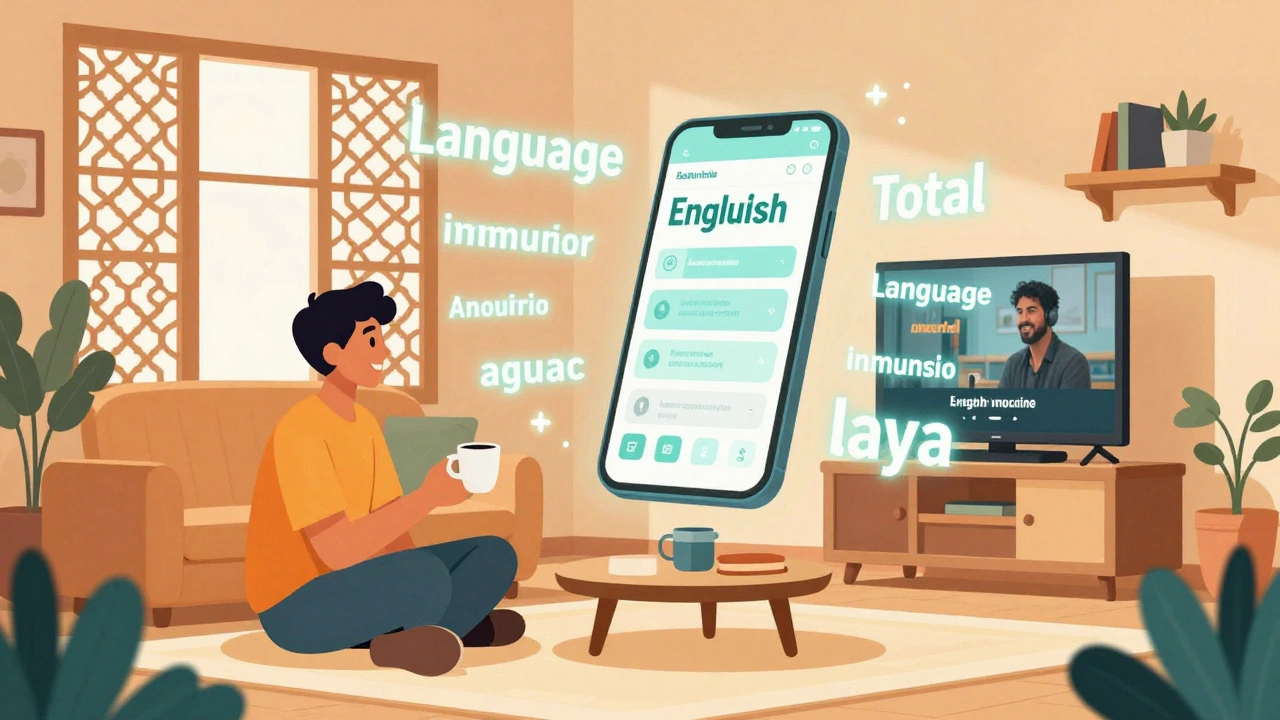
Total Immersion is the practice of surrounding yourself with the target language in all aspects of daily life. This is the single most effective accelerator for language learning. When you live in Birmingham, London, or New York, immersion happens naturally. But if you are learning remotely, you must manufacture this environment. It’s not enough to watch Netflix occasionally. You need to make English your default operating system.
Start by changing the language settings on every device you own. Your phone, your computer, your smart TV-everything should switch to English. This forces your brain to process interface commands in the new language. You’ll stumble over words like "settings" or "download," but that friction is where learning happens. Next, curate your media consumption. Stop watching content with subtitles in your native language. Switch to English subtitles, and eventually, turn them off completely. Listen to podcasts while you commute, cook, or clean. The key is consistency. Thirty minutes of focused listening is better than three hours of sporadic study once a week.
Another crucial aspect of immersion is consuming content that matches your current level, not your desired level. If you can’t understand 80% of a news broadcast, it’s noise, not input. Look for "comprehensible input"-material that is slightly above your current ability but still understandable through context. For beginners, this might mean children’s stories or simplified news sites. For intermediate learners, it could be YouTube vlogs or sitcoms with everyday dialogue. The goal is to train your ear to recognize patterns without translating every word in your head.
Speak From Day One: The Output Imperative
Listening is passive; speaking is active. Many learners fall into the "silent period" trap, believing they need to know everything before they open their mouths. This is a mistake. You must produce language immediately, even if it’s broken. The faster you start speaking, the faster you identify your weak spots. Shadowing Technique is a method where you repeat audio aloud simultaneously with the speaker, mimicking their intonation, speed, and emotion. This bridges the gap between hearing sounds and producing them.
To practice shadowing, find a short audio clip of a native speaker. Listen to a sentence, pause it, and repeat it exactly as you heard it. Pay attention to the rhythm and stress. Don’t worry about meaning initially; focus on the music of the language. Do this for ten minutes every day. Within weeks, your pronunciation will improve significantly because you are training your mouth muscles to move in new ways.
But shadowing alone isn’t enough. You need real conversation. This is where Language Exchange Partners come in. These are native speakers who want to learn your language, creating a mutually beneficial arrangement. Platforms like Tandem or HelloTalk connect you with these partners globally. Alternatively, hire a tutor on services like iTalki or Preply for structured practice. The difference is accountability. When you have a scheduled call, you prepare. You force yourself to formulate thoughts in English rather than translating from your native tongue.
- Find a partner: Use apps to find someone interested in your language.
- Set a timer: Spend 30 minutes speaking only English, then 30 minutes in your native language.
- Focus on topics: Discuss hobbies, work, or daily routines to build relevant vocabulary.
- Ask for corrections: Tell your partner to interrupt you when you make major errors.
Vocabulary: Quality Over Quantity
A common misconception is that you need to know thousands of words to hold a conversation. In reality, the top 1,000 most frequent words in English account for approximately 85% of all spoken communication. Instead of memorizing random lists of animals or furniture, focus on high-frequency verbs and connectors. Words like "get," "make," "think," "because," and "however" are the glue of sentences. Mastering these allows you to construct complex ideas with simple vocabulary.
Use Spaced Repetition Systems (SRS) to retain these words. Apps like Anki or Memrise use algorithms to show you flashcards just before you are likely to forget them. This is scientifically proven to be more efficient than rote repetition. However, don’t just memorize isolated words. Learn phrases. Instead of learning the word "decision," learn "make a decision." Context helps your brain retrieve the word faster during conversation. This technique, known as collocation learning, ensures you sound natural rather than robotic.
| Method | Efficiency | Best For | Time Commitment |
|---|---|---|---|
| Rote Memorization | Low | Specific technical terms | High (inefficient) |
| Spaced Repetition (SRS) | High | Long-term retention of core words | Medium (15 mins/day) |
| Contextual Phrases | Very High | Fluency and natural speech | Integrated into daily study |

Grammar: Learn It By Doing
Don’t spend months studying grammar books. Grammar is the skeleton of language, but you need flesh and blood to move. Learn grammar rules only when you encounter a problem in communication. If you keep mixing up "since" and "for," then study that specific rule. This "just-in-time" learning is far more memorable than "just-in-case" studying. Your brain prioritizes information that solves an immediate problem.
Focus on the core tenses first: present simple, past simple, and future with "will" or "going to." These cover the vast majority of daily interactions. Once you are comfortable, expand to present perfect and conditionals. Avoid getting bogged down in obscure exceptions until you are advanced. Native speakers break grammar rules all the time. Your priority is clarity, not academic correctness.
Mental Shifts for Speed
The biggest barrier to fast learning is often psychological. Fear of embarrassment stops many from speaking. You must accept that making mistakes is part of the process. Every error is data. It tells you what you don’t know yet. Embrace the awkwardness. The more you laugh at your own mistakes, the less power they have over you.
Also, stop translating. When you see a chair, think "chair," not the word in your native language. Translation creates a lag in your thinking. To eliminate it, label objects in your house with sticky notes. Narrate your actions out loud: "I am drinking coffee," "I am opening the door." This builds a direct connection between concepts and English words, bypassing your native language entirely.

Tools and Resources for 2026
In 2026, technology has made language learning more accessible than ever. AI-powered tutors can provide instant feedback on pronunciation and grammar. Tools like ELSA Speak or Speechify use speech recognition to analyze your accent and offer precise corrections. These tools are invaluable for self-study because they provide the immediate feedback loop that a human teacher might not always have time for.
However, technology cannot replace human interaction. Use AI for drilling and practice, but reserve your energy for real conversations. Combine the precision of tech with the empathy of humans. Join online communities related to your interests-gaming, cooking, coding-but participate in English-speaking channels. This integrates language learning into your existing passions, making it feel less like work and more like play.
Creating Your Personalized Plan
There is no one-size-fits-all schedule, but consistency is non-negotiable. Here is a sample daily routine for rapid progress:
- Morning (15 mins): Review SRS flashcards for vocabulary. Shadow a podcast episode while getting ready.
- Commute/Chores (30 mins): Listen to an English podcast or audiobook. Focus on understanding the gist, not every word.
- Lunch Break (10 mins): Read one article in English on a topic you enjoy. Highlight three new phrases.
- Evening (30 mins): Active speaking practice. Either with a tutor, a language partner, or by recording yourself speaking on a topic and reviewing it.
- Before Bed (5 mins): Write down five sentences about your day in a journal. Check them for errors using a tool like Grammarly.
This routine totals roughly 90 minutes a day. It’s intense, but it yields results. If you can’t commit that much, scale it down, but don’t skip days. Daily exposure keeps the neural pathways active. Missing a few days breaks the momentum and makes restarting harder.
Remember, the fastest way to learn English is to use it. Treat English not as a subject to study, but as a tool to live. The moment you start using it to solve problems, entertain yourself, and connect with others, the learning accelerates naturally. You aren’t just learning a language; you’re adopting a new lens through which to view the world.
How long does it take to become fluent in English?
Fluency is subjective, but with intensive immersion (4-6 hours a day), most learners reach conversational fluency in 3-6 months. With moderate study (1 hour a day), it may take 1-2 years. Consistency matters more than intensity in the long run.
Is it better to learn grammar first or vocabulary?
Learn both simultaneously, but prioritize high-frequency vocabulary and basic sentence structures. You can communicate with very little grammar if you have the right words. Complex grammar rules should be learned as you encounter gaps in your expression.
Can I learn English without speaking to anyone?
You can achieve high reading comprehension without speaking, but true fluency requires output. Speaking trains your mouth muscles and reduces the mental lag of translation. Try shadowing or talking to yourself if you don’t have a partner yet.
What are the best apps for learning English in 2026?
For vocabulary, use Anki or Memrise. For pronunciation, try ELSA Speak. For conversation, use Tandem or HelloTalk. For comprehensive lessons, Duolingo is good for beginners, but Babbel offers more structured grammar explanations.
How do I overcome the fear of making mistakes?
Remind yourself that mistakes are essential for learning. Native speakers appreciate the effort. Start with low-stakes environments like language exchange apps or online forums before moving to face-to-face conversations. Celebrate small wins to build confidence.
Should I watch movies with subtitles?
Yes, but strategically. Start with English subtitles if your level is beginner. Move to no subtitles as you improve. Avoid subtitles in your native language as they encourage reading rather than listening. Re-watch scenes to catch missed details.
What is the "Shadowing Technique"?
Shadowing involves listening to native speech and repeating it aloud simultaneously, mimicking the speaker's tone, speed, and intonation. It improves pronunciation, rhythm, and listening skills by engaging both auditory and motor memory.
How many words do I need to know to be fluent?
Knowing the top 1,000-2,000 words covers about 85-90% of daily conversations. For professional or academic fluency, aim for 5,000+ words. Focus on frequency lists rather than random vocabulary to maximize efficiency.