


MBBS Total Cost & Loan Estimator
Enter your estimated expenses to calculate the total investment for a 5-year MBBS program (4.5 years academic + 1 year internship) and potential loan burden.
Expense Inputs
₹
Excludes hostel and one-time fees.
₹
Development funds or admission fees.
₹
₹
Personal spending, transport, etc.
Financial Summary
Enter details and click Calculate to see your breakdown.
Education Loan Calculator
₹
Estimated Monthly EMI:
₹0
Total Repayment: ₹0
You cleared the NEET-UG exam. You studied for two years, memorized diagrams of the human heart until they were burned into your retinas, and finally saw a score that opens doors. Now comes the part nobody warns you about enough: the money. The question isn't just "Can I get in?" It's "Can I afford to stay?"
When people ask what is the fees of MBBS in India, there is no single number. The answer swings wildly depending on where you go. We are talking about a difference between paying ₹50,000 total or ₹1 crore over four and a half years. That gap determines whether your parents sell land, take a massive loan, or if you study essentially for free.
| Institution Type | Annual Tuition (Approx.) | Total Course Cost (4.5 Years) | Admission Process |
|---|---|---|---|
| Government Medical Colleges | ₹10,000 - ₹1,00,000 | ₹50,000 - ₹5,00,000 | NEET Rank (MCC/State Counseling) |
| Private Deemed Universities | ₹15,00,000 - ₹30,00,000 | ₹70,00,000 - ₹1,50,00,000 | NEET Qualifying + Management Quota |
| Private State Colleges | ₹8,00,000 - ₹15,00,000 | ₹40,00,000 - ₹70,00,000 | State Counseling / NRI Quota |
| AIIMS & Central Institutes | ₹1,000 - ₹5,000 | Under ₹25,000 | All India Quota via MCC |
The Government Route: High Competition, Low Cost
If you crack a top rank in NEET-UG, the financial burden drops to almost nothing. Government medical colleges in India are subsidized heavily by the state and central governments. At institutions like AIIMS Delhi or JIPMER Puducherry, the annual fee can be as low as ₹1,000 to ₹5,000. Yes, per year. Even at reputable state government colleges in states like Maharashtra, Tamil Nadu, or Karnataka, the yearly tuition rarely exceeds ₹1 lakh.
But here is the catch: getting a seat is brutal. For the All India Quota (15% of seats), you often need a score above 650 out of 720. For state quotas, it varies, but generally, anything below 550 makes government seats difficult in populated states. If you are aiming for this route, remember that the "fee" includes hostel charges, which can add another ₹20,000-₹50,000 annually. Still, compared to private options, it’s negligible.
Private Medical Colleges: The Financial Reality
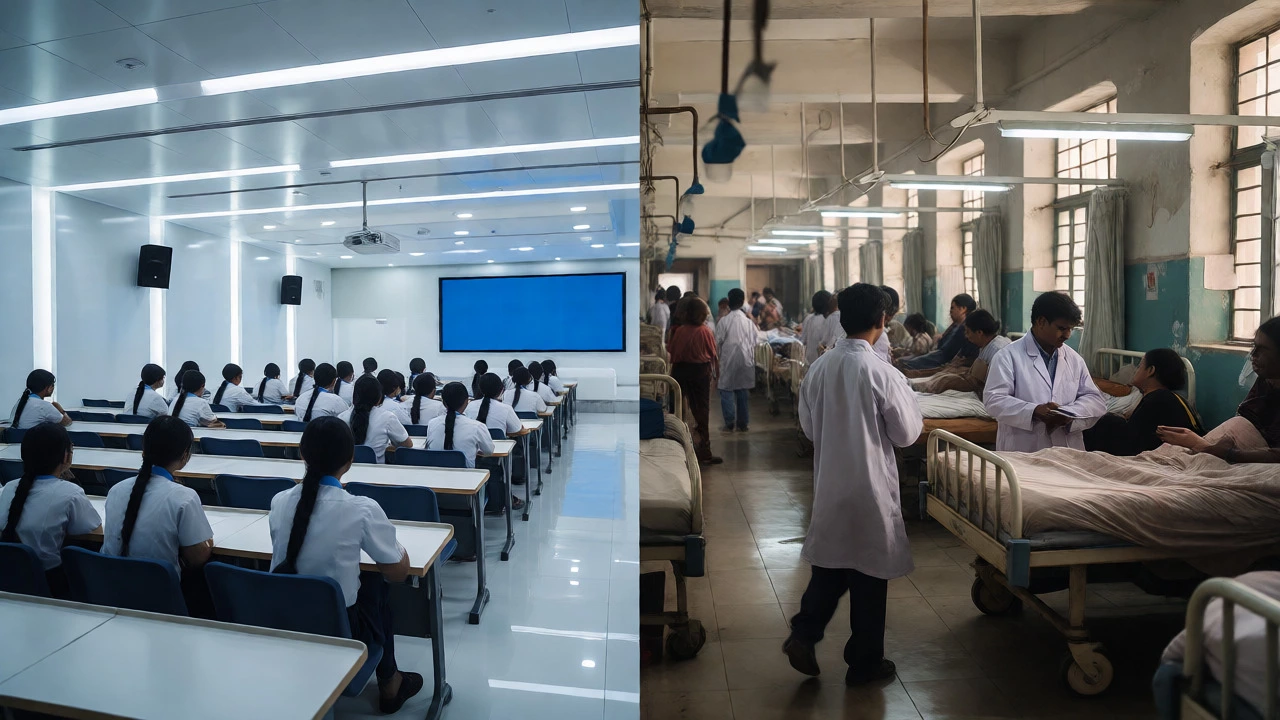
Most students don’t get government seats. This is where private colleges enter the picture. But "private" is a broad term. You have two main categories here: State Private Colleges and Deemed Universities. They operate under different regulatory frameworks, and their price tags reflect that.
Deemed Universities set their own fees because they fall outside state government regulation. This freedom leads to higher costs. In cities like Bangalore, Hyderabad, or Mumbai, deemed universities charge anywhere from ₹15 lakh to ₹30 lakh per year. Over the course of the MBBS program (4.5 years academic + 1 year internship), you are looking at a total investment between ₹70 lakh and ₹1.5 crore. This doesn't include living expenses.
State private colleges are slightly more regulated. Their fees are capped by state committees, though these caps vary significantly by region. In Uttar Pradesh or Rajasthan, fees might hover around ₹8-12 lakh per year. In Kerala or Punjab, they could be lower. However, beware of "management quota" seats. These are seats sold directly by the college, often requiring a hefty donation or capitation fee upfront, sometimes ranging from ₹20 lakh to ₹50 lakh, separate from the annual tuition.
NRI and Minority Seats: A Different Ballgame
If you have Non-Resident Indian (NRI) status or belong to a minority community, there are specific seats reserved for you. These usually come with a premium price tag. NRI seats in private colleges can cost $20,000 to $50,000 USD per year. Why so high? Because these seats bypass the general merit list competition. You still need to qualify NEET, but the cutoff scores are significantly lower. For families who can afford it, this is a viable shortcut to a medical degree without needing a top-tier rank.
Minority institution seats offer a middle ground. These colleges receive some government aid but retain autonomy. Fees are typically lower than deemed universities but higher than government colleges. Check with the specific institution, as rules change frequently regarding eligibility for these quotas.
Hidden Costs: Beyond Tuition
Tuition is just the headline number. When budgeting for an MBBS degree, you must account for the ancillary expenses that pile up quickly. Many students overlook these until they are stuck.
- Hostel and Mess: Expect to pay ₹50,000 to ₹1.5 lakh per year depending on the city and facility quality. Metro cities like Delhi or Mumbai are pricier.
- Books and Equipment: Medical textbooks are expensive. A standard set of books (Gray’s Anatomy, Guyton, Robbins) plus clinical instruments (stethoscope, diagnostic kit) can cost ₹20,000-₹30,000 initially. New editions come out every few years, forcing repeat purchases.
- Exam Fees: University practicals and theory exams incur separate fees each semester, adding up to ₹5,000-₹10,000 annually.
- Internship Stipend: During your final year, you work as an intern. Government colleges pay a stipend (₹10,000-₹25,000/month). Private colleges vary wildly; some pay nothing, others pay less than minimum wage. Do not count on this income to cover major expenses.
Financing Your Education: Loans and Scholarships
Given the steep costs of private education, most families rely on loans. Banks like SBI, HDFC, and PNB offer education loans specifically for professional courses. Interest rates for medical loans typically range between 8.5% and 11%. Some banks waive collateral requirements for loans up to ₹7.5 lakh, but for larger amounts, you will need property or fixed deposits.
Don't ignore scholarships. The National Scholarship Portal offers schemes for SC/ST/OBC students. Additionally, many state governments provide fee reimbursement for students studying in private colleges within their state. Always check the Directorate of Medical Education website for your respective state before counseling begins. Missing a deadline for scholarship application can cost lakhs.

How to Calculate Your Total Budget
To avoid surprises, use this simple formula when comparing colleges:
Total Cost = (Annual Tuition × 4.5) + (Hostel/Mess × 5) + (One-time Donation/Capitation) + (Living Expenses × 5)
For example, if a private college charges ₹10 lakh/year tuition, ₹1 lakh/year hostel, and demands a ₹20 lakh donation, your calculation looks like this:
- Tuition: ₹10L × 4.5 = ₹45L
- Hostel: ₹1L × 5 = ₹5L
- Donation: ₹20L
- Living: ₹1.5L × 5 = ₹7.5L
- Total: ₹77.5 Lakhs
Compare this against a government college where tuition is ₹50k/year, hostel is ₹20k/year, and no donation exists. The difference is stark.
Related Concepts and Future Scope
Understanding fees also means understanding value. Is a ₹1 crore degree worth more than a ₹5 lakh one? Not necessarily. The Medical Council of India (MCI), now replaced by the National Medical Commission (NMC), ensures that all recognized colleges meet basic infrastructure standards. A graduate from a government college and a deemed university both sit for the same NEXT Exam (National Exit Test) upon graduation. The knowledge base is standardized.
However, networking and clinical exposure differ. Top-tier private hospitals attached to deemed universities may offer advanced tech access earlier. Yet, government hospitals handle far more patient volume, giving interns superior hands-on experience in common diseases. Factor this into your decision. Sometimes, the cheaper option provides better training.
Is NEET required for private MBBS colleges?
Yes, absolutely. Regardless of whether you apply to a government, private, or deemed university, qualifying the NEET-UG exam is mandatory for admission to any MBBS course in India recognized by the NMC. There are no direct admissions without a valid NEET score.
What is the average fee for MBBS in government colleges?
The average annual tuition fee for government medical colleges in India ranges from ₹10,000 to ₹1,00,000. Elite institutes like AIIMS charge even less, often under ₹5,000 per year. Hostel and mess charges are additional but remain affordable compared to private institutions.
Do private colleges charge capitation fees?
Many private colleges, especially those with management quotas, effectively charge capitation fees or donations. While officially banned in some states, these fees often appear as "development funds" or "institutional charges." Always ask for a clear breakdown of all one-time payments during the counseling process.
Are education loans available for MBBS in India?
Yes, public sector banks like SBI, Bank of Baroda, and Canara Bank, along with private lenders, offer education loans for MBBS. Loans up to ₹7.5 lakh usually do not require collateral. Interest rates vary between 8.5% and 11%, and repayment typically begins after the completion of the course plus a moratorium period.
Which state has the lowest MBBS fees in private colleges?
States like Haryana, Punjab, and parts of Uttar Pradesh often have relatively lower fee structures in private colleges due to state-level fee regulation committees. However, competition for these seats is fierce. Always verify the current year's fee notification issued by the state counseling authority.