Vocational School Type Finder
Recommended Path:
Typical Duration:
Cost Structure:
Why this fits you:
Examples of programs:
You want a job that pays well, but you don't necessarily need a four-year university degree. You’ve heard the term vocational school is an educational institution focused on preparing students for specific trades or skilled professions through hands-on training rather than academic theory. But if you ask five different people what else it’s called, you might get five different answers. Is it a trade school? A technical college? A community college?
The confusion is real. The education sector uses a lot of overlapping terms, and they often mean slightly different things depending on where you live and what industry you are targeting. Getting the terminology right matters because it helps you find the right programs, understand the costs, and know exactly what kind of credential you will walk away with.
Trade Schools: The Hands-On Approach
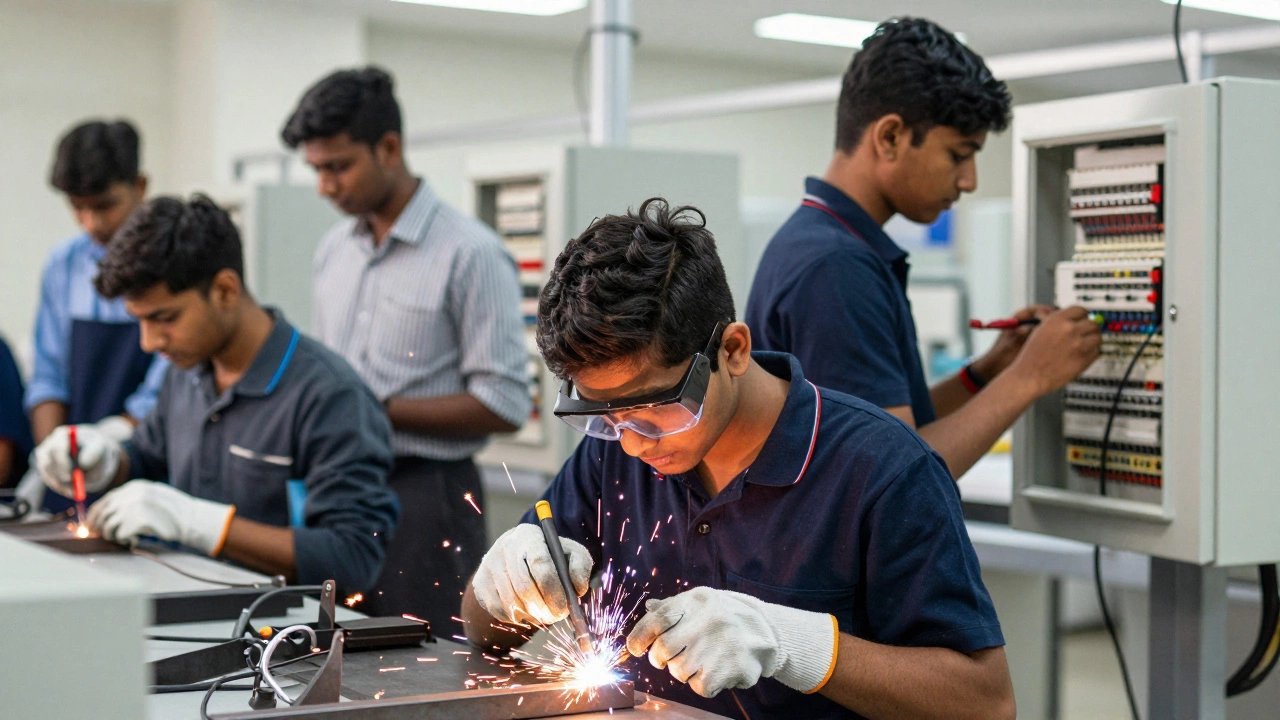
When people talk about learning a craft like plumbing, electrical work, or carpentry, they usually say "trade school." This is perhaps the most common synonym for vocational school in the construction and maintenance sectors. A trade school is a specialized educational program designed to teach students the practical skills needed for manual labor jobs such as welding, HVAC repair, or automotive mechanics.
The focus here is entirely on doing. You spend very little time reading textbooks and plenty of time holding tools. If you want to become an electrician, you go to an electrical trade school. These programs are often shorter than traditional degrees, sometimes lasting only six months to two years. They prepare you directly for entry-level positions or for entering an apprenticeship.
In the UK, this concept aligns closely with further education (FE) colleges that offer NVQs (National Vocational Qualifications) or BTECs in applied subjects. In the US, trade schools are often private institutions, though public options exist. The key takeaway is that "trade" implies manual skill and physical application.
Technical Colleges and Institutes: The Tech-Focused Route
If the job involves more technology than hammering nails, the name changes slightly. You’ll hear terms like technical college is an educational institution that provides advanced vocational training in fields such as information technology, healthcare support, engineering technology, and business administration. or "technical institute."
Think about careers like medical assisting, dental hygiene, paralegal studies, or IT network administration. These roles require specific technical knowledge and certification but not necessarily a liberal arts background. Technical colleges bridge the gap between pure manual labor and white-collar office work. They often partner with local industries to ensure their curriculum matches current employer needs.
In many regions, especially in Europe and parts of Asia, "polytechnic" is another strong synonym here. Polytechnics emphasize applied science and engineering. If you are looking into coding bootcamps or data analytics certificates, you are essentially engaging with the modern evolution of the technical college model.
Career Colleges: The Private Sector Alternative
You might also see the term "career college" used frequently, particularly in marketing materials. A career college is typically a private, for-profit institution that offers accelerated programs aimed at quickly placing students into specific high-demand jobs.
This term is heavily associated with the United States and Canada. Career colleges often specialize in niche areas like cosmetology, culinary arts, or radiologic technology. Because they are often for-profit, they can be more expensive than public alternatives, but they may offer flexible scheduling and faster graduation times.
It is important to vet these institutions carefully. Look for accreditation status and job placement rates. While some career colleges provide excellent ROI (Return on Investment), others have faced criticism for aggressive recruitment tactics. Always check if the specific program you are interested in is accredited by a recognized body relevant to that industry.

Community Colleges: The Public Option
In North America, community college is a publicly funded two-year institution that offers associate degrees, certificate programs, and vocational training alongside general education courses. acts as a massive hub for vocational education. While community colleges do offer transfer pathways to four-year universities, a huge portion of their student body is there for career-specific training.
You can find automotive technology, nursing assistant certifications, and welding programs at your local community college. The advantage here is cost. Tuition is significantly lower than private trade schools or universities. Additionally, community colleges are deeply embedded in their local communities, meaning they often have established relationships with local employers for internships and hiring.
In the UK, this role is largely filled by Further Education (FE) colleges and sixth form colleges. They offer similar vocational pathways, including T-Levels, which are the new technical qualifications replacing many older BTECs. If you are looking for affordable, reputable vocational training, checking your local public college system should be step one.
Apprenticeships: Earning While You Learn
Sometimes, the "school" isn't a building at all. An apprenticeship is a structured training program that combines on-the-job training with classroom instruction, allowing individuals to earn a wage while learning a skilled trade. is a powerful alternative to traditional schooling. In this model, you work for an employer who trains you, often while you attend classes part-time.
This is the gold standard for trades like plumbing, electrical work, and machining. You graduate with zero debt and several years of experience under your belt. In the UK, apprenticeships range from Level 2 (equivalent to GCSEs) to Level 7 (Master’s degree equivalent). In the US, registered apprenticeships are overseen by the Department of Labor.
While not a "school" in the traditional sense, it is a primary pathway for vocational education. Many trade schools actually serve as the classroom component of an apprenticeship. If you hate the idea of taking out loans, look for registered apprenticeship programs first.
| Term | Primary Focus | Typical Duration | Cost Structure | Best For |
|---|---|---|---|---|
| Trade School | Manual trades (plumbing, electrical) | 6 months - 2 years | Varies (Private/Public) | Hands-on craftspeople |
| Technical College | Tech & Health (IT, Medical) | 1 - 2 years | Moderate | Allied health & tech support |
| Career College | Niche careers (Cosmetology, Culinary) | Accelerated | Higher (Often For-Profit) | Quick entry into specific fields |
| Community College | Broad vocational & academic | 2 years (Associate) | Low (Publicly Funded) | Cost-conscious learners |
| Apprenticeship | On-the-job training | 3 - 5 years | Free (You Earn) | Debt-free career starters |

Why the Terminology Matters for Your Career
Using the right words helps you navigate the education landscape. If you search for "university," you will miss out on excellent trade programs. If you search for "trade school," you might overlook high-tech opportunities in cybersecurity or healthcare.
Employers also use these terms differently. A resume listing "Vocational Training" might sound vague. Listing "Certified Welding Technician from [Name] Technical Institute" sounds specific and credible. When you apply for financial aid or scholarships, knowing whether your program is classified as a certificate, diploma, or associate degree is crucial. Some grants only apply to certain types of institutions.
Furthermore, accreditation varies by type. A trade school might be accredited by a trade-specific body, while a community college holds regional accreditation. Understanding this distinction protects you from investing time and money in programs that employers won’t recognize.
How to Choose the Right Path
Don’t just pick a name; pick a outcome. Start by identifying the job you want. Then, reverse-engineer the education required. Does the job posting ask for a license? A certification? An associate degree?
- Check Licensing Requirements: Fields like nursing, electrical work, and cosmetology require state or national licenses. Ensure your chosen school prepares you for those specific exams.
- Verify Accreditation: Look for institutional accreditation (for the whole school) and programmatic accreditation (for the specific major). This ensures quality and eligibility for federal aid in many countries.
- Ask About Job Placement: Reputable vocational schools track their graduates. Ask for recent job placement rates and average starting salaries. If they hesitate, that’s a red flag.
- Visit the Campus: See the equipment. Are the tools up-to-date? Do the instructors have real-world industry experience? You want to learn on machines that exist in today’s workplace, not ones from ten years ago.
Vocational education is evolving. It’s no longer just about factory work. It includes green energy installation, drone piloting, and advanced manufacturing. By understanding the various names and structures of these programs, you open yourself up to a wider range of high-paying, stable careers that don’t require the traditional four-year route.
Is a vocational school the same as a community college?
Not exactly, though they overlap. Community colleges are public institutions that offer both academic transfer degrees and vocational certificates. Vocational schools can be private or public and focus exclusively on career-specific training without general education requirements. Community colleges are generally cheaper and offer broader course options.
What is the difference between a trade school and a technical school?
Trade schools typically focus on manual, hands-on crafts like plumbing, welding, or carpentry. Technical schools focus more on technology-driven fields like IT, healthcare support, or engineering technology. Both are forms of vocational education, but the day-to-day work differs significantly.
Are vocational schools respected by employers?
Yes, highly so in skilled trades and technical fields. Employers in healthcare, construction, and IT often prefer candidates with specific certifications and hands-on training over general degrees. The key is ensuring the program is accredited and recognized within that specific industry.
Can I get financial aid for vocational school?
In many countries, yes. In the US, students at accredited vocational schools can often apply for Federal Student Aid (FAFSA). In the UK, students may access Advanced Learner Loans or government-funded apprenticeships. Always check the specific funding options available for your location and chosen institution.
How long does it take to finish a vocational program?
It varies widely. Short-term certificate programs can take as little as three to six months. Associate degree programs typically take two years. Apprenticeships can last three to five years. The duration depends on the complexity of the skill and the depth of the credential you are pursuing.