

YouTube English Learning Style Analyzer
1
2
3
Your Personalized Strategy:
Content Mix
Daily Time
Key Technique
You sit down with your laptop, ready to finally crack the code on learning English. You open YouTubethe world's second-largest search engine and a massive repository of user-generated video content, type in "how to speak English," and are instantly bombarded by thousands of results. Vlogs, grammar lectures, movie clips, and accent tutorials flash across your screen. It feels like an infinite library of knowledge is right at your fingertips. But here is the burning question: Is it actually possible to become fluent using only this free platform, or are you just consuming entertainment disguised as education?
The short answer is yes. The long answer is complicated. Learning English from YouTube is not a magic pill. It is a tool-a very powerful one, but still just a tool. If you treat it like passive background noise, you will learn nothing. If you treat it like a structured classroom with active participation, you can achieve remarkable fluency. The difference lies entirely in how you curate your feed and structure your study sessions.
Why YouTube Works for Language Acquisition
Traditional language classes often fail because they focus too heavily on rules and not enough on usage. They teach you the anatomy of a sentence rather than how to breathe life into it. YouTube flips this script. It offers immersion without leaving your room. When you watch a native speaker explain a concept, tell a joke, or argue about politics, you are exposed to the natural rhythm, slang, and cultural context of the language. This aligns perfectly with the Comprehensible Input Hypothesisa theory proposed by linguist Stephen Krashen suggesting that language acquisition occurs when learners understand messages slightly above their current level.
Unlike a textbook, which is static, YouTube is dynamic. You hear different accents-American, British, Australian, Indian. You see facial expressions that convey meaning beyond words. You observe body language. These non-verbal cues are critical for true understanding. For example, watching a tutorial on cooking might seem unrelated to language learning, but if you follow along, you learn imperative verbs ("chop," "stir," "simmer") in a practical context. This method, known as Content-Based Instructionan approach where the target language is used as a medium to teach subject matter, makes vocabulary stickier because it is tied to a real-world action.
Moreover, the algorithm works in your favor if you train it correctly. Once you start watching English content, YouTube suggests more similar videos. This creates a feedback loop of exposure. However, you must be careful not to let the algorithm trap you in a bubble of overly simplified content. You need to push past the "easy" zone to keep growing.
Curating Your Channel List: The Right Mix
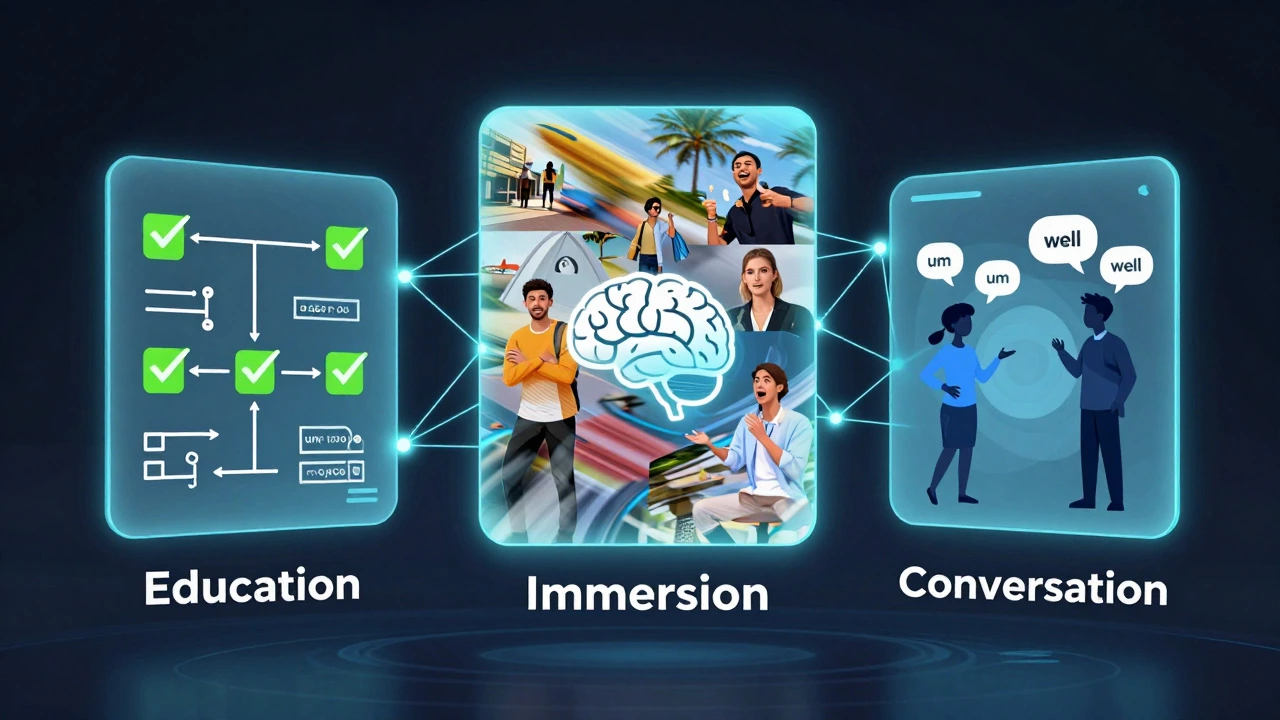
Not all English channels are created equal. To make progress, you need a balanced diet of content. Think of your subscription list as a curriculum. You need three distinct types of channels to cover all bases: educational, immersive, and conversational.
- Educational Channels: These are your teachers. They break down grammar, pronunciation, and idioms. Look for channels that offer clear explanations and visual aids. Examples include channels dedicated to specific grammar points or pronunciation drills. They provide the scaffolding you need to understand the rules.
- Immersive Channels: These are for listening practice. Subscribe to vloggers, news outlets, or documentary creators who speak naturally. Do not worry if you miss some words. The goal here is to get used to the speed and flow of native speech. Channels featuring daily life routines, travel vlogs, or tech reviews work well here.
- Conversational Channels: These show interaction. Watch interviews, podcasts recorded on video, or debate shows. Here, you learn how people interrupt each other, how they agree or disagree, and how they use filler words like "um," "well," or "you know." This is crucial for sounding natural rather than robotic.
A common mistake beginners make is sticking only to educational channels. While helpful, these often feature scripted, slow-paced speech. Real-life conversations are messy. By including immersive and conversational content, you prepare yourself for actual interactions.
| Content Type | Primary Benefit | Best For Level | Example Activity |
|---|---|---|---|
| Educational Tutorials | Grammar & Vocabulary Rules | Beginner to Intermediate | Watching a lesson on present perfect tense |
| Vlogs & Daily Life | Natural Speed & Slang | Intermediate to Advanced | Following a day-in-the-life video |
| News & Documentaries | Formal Register & Complex Topics | Advanced | Listening to a political analysis segment |
| Podcasts & Interviews | Conversational Flow & Interruptions | Intermediate to Advanced | Watching a celebrity interview |
Active vs. Passive Watching: The Game Changer
This is where most people fail. They put on a video while doing dishes or scrolling through their phone. This is passive consumption. Your brain registers the sound but does not encode the language. To learn, you must engage actively. Active watching requires effort, focus, and repetition.
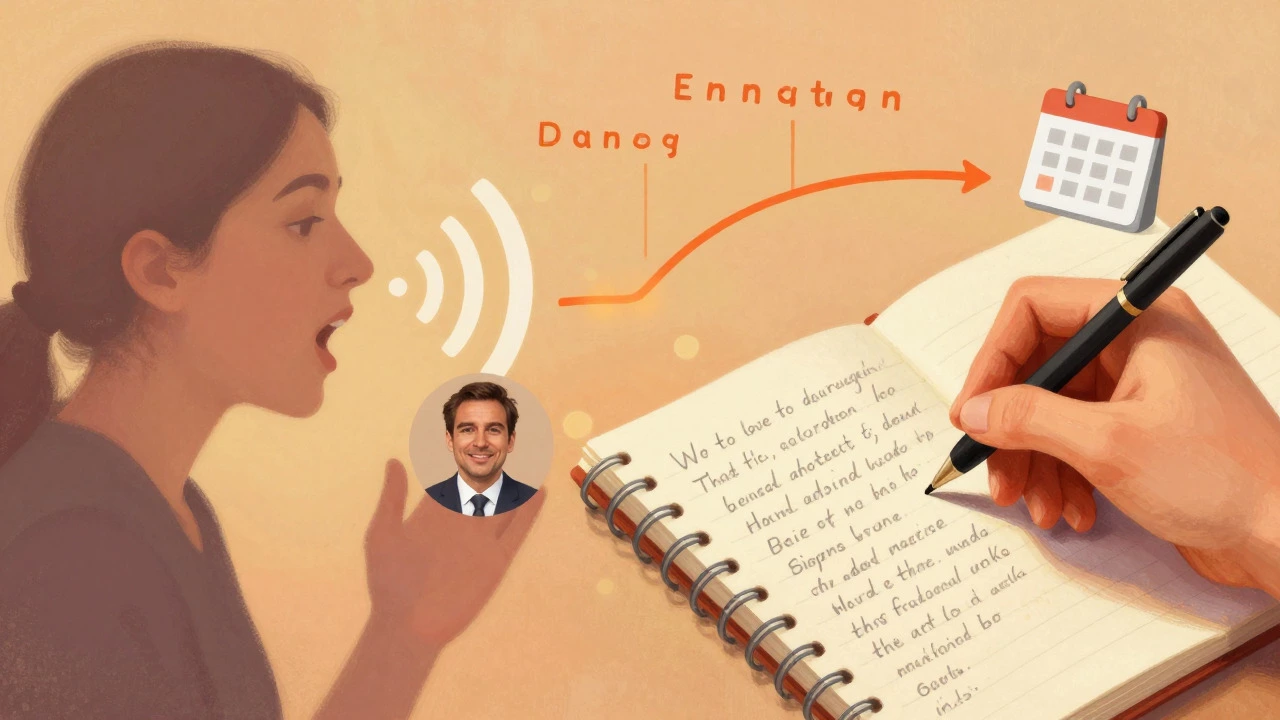
Try the Shadowing Techniquea language learning method where the learner listens to a native speaker and repeats what they say simultaneously, mimicking intonation and rhythm. Pick a short clip, perhaps 30 seconds long. Listen to it once. Then, play it again and repeat every word out loud, trying to match the speaker's speed, tone, and emotion exactly. It feels awkward at first, but it trains your mouth muscles to produce English sounds correctly. This bridges the gap between recognizing words and speaking them.
Another effective strategy is the pause-and-predict method. Pause the video before the speaker finishes a sentence. Try to guess what they will say next based on context clues. Then, press play to check your prediction. This engages your predictive processing, making you an active participant in the conversation rather than a passive observer.
Take notes. Keep a notebook or a digital document open. Write down new phrases, not just isolated words. Context is king. Instead of writing "run," write "run out of time." This helps you understand collocations-words that naturally go together. Review these notes weekly. Without review, the information fades quickly due to the Forgetting Curvea theory describing how information is lost over time when there is no attempt to retain it.
Leveraging Technology: Subtitles and Speed
YouTube provides tools that can either help or hinder your progress. Subtitles are the biggest debate in online language learning. Should you use them? Yes, but strategically.
If you are a beginner, use subtitles in your native language to grasp the general idea. As you improve, switch to English subtitles. This connects the sound of the word with its spelling. Finally, aim to turn off subtitles entirely. Relying on text prevents your ears from adapting to the spoken word. You want to train your auditory processing, not your reading skills.
Use the playback speed settings. If a speaker is too fast, slow the video down to 0.75x speed. This allows you to catch individual syllables and linking sounds. Conversely, if you are advanced, try speeding up content to 1.25x or 1.5x. This forces your brain to process information faster, making normal-speed speech feel easier later on.
Create playlists. Organize your learning by topic. Have a playlist for business English, another for travel phrases, and another for casual slang. This thematic organization helps build semantic networks in your brain, connecting related vocabulary items.
Overcoming Common Pitfalls
Even with the best intentions, distractions abound. The YouTube interface is designed to keep you clicking, not learning. You click on an English lesson, and suddenly you are watching a cat video for twenty minutes. Discipline is required.
Set a timer. Decide beforehand that you will study for 20 minutes. When the timer goes off, stop. This prevents burnout and keeps sessions focused. Use website blockers if necessary to restrict access to non-educational content during study hours.
Another pitfall is inconsistency. Watching for five hours one day and then nothing for two weeks yields poor results. Language learning thrives on frequency. Ten minutes every day is far more effective than two hours once a week. Consistency builds neural pathways. Make it a habit, like brushing your teeth.
Do not neglect output. Watching YouTube improves your listening and reading comprehension. It does not automatically improve your speaking or writing. You must supplement your YouTube study with active production. Speak aloud, write summaries of the videos you watch, or find a language partner to discuss the content. Input alone is not enough; you need output to solidify your skills.
Building a Sustainable Routine
To truly master English through YouTube, integrate it into your daily life. Start small. Commit to one video per day. Choose content that interests you personally. If you love cooking, watch English cooking channels. If you are into tech, watch gadget reviews. Interest drives engagement, and engagement drives retention.
Track your progress. Note which topics you find difficult. Are you struggling with phrasal verbs? Search specifically for those. Are you confused by American idioms? Find a channel dedicated to them. Tailor your input to your weaknesses.
Remember, fluency is a marathon, not a sprint. There will be days when you feel stuck. That is normal. Push through. Celebrate small victories, like understanding a joke without subtitles or catching a rapid-fire sentence. Over time, these small wins accumulate into significant proficiency.
YouTube is a treasure trove for language learners, but it demands effort. It is not a substitute for a teacher, but it is a powerful complement. By curating your content, engaging actively, and maintaining consistency, you can indeed learn English effectively from this platform. The key is to move from being a viewer to being a student.
Is YouTube enough to learn English completely?
YouTube is excellent for listening, vocabulary, and cultural context, but it lacks interactive feedback. To reach full fluency, you should combine YouTube study with speaking practice, such as language exchange partners or tutors, to correct pronunciation and grammar errors in real-time.
Should I use subtitles when learning English on YouTube?
Yes, but transition gradually. Start with native language subtitles if needed, then switch to English subtitles to connect sound and spelling. Eventually, remove subtitles to train your ear to rely solely on audio cues, which is essential for real-world conversation.
How many hours a day should I watch English videos?
Quality matters more than quantity. Aim for 15-30 minutes of active, focused study daily rather than hours of passive watching. Consistency is key. Short, regular sessions prevent burnout and reinforce memory retention better than sporadic long sessions.
What is the best type of content for intermediate learners?
Intermediate learners benefit most from vlogs, interviews, and documentaries. These formats provide natural speech speeds, diverse accents, and complex topics, pushing learners beyond basic survival English into more nuanced and authentic communication styles.
Can I improve my pronunciation using YouTube?
Yes, by using the shadowing technique. Mimic native speakers' intonation, stress, and rhythm by repeating phrases aloud immediately after hearing them. Focus on mouth movements shown in close-up videos to refine your articulation.