


Exam Difficulty & Competition Calculator
Your Preparation Profile
Select the exam you are targeting to see detailed insights.
Low (1-3 hrs/day)
High (10+ hrs/day)
Moderate
Inconsistent
Daily Routine
Average
This tool estimates difficulty based on statistical data from the article. It is for educational purposes only. Actual success depends on individual aptitude and strategy.
Competition Overview
Applicants
-
Selections
-
Success Rate
-
Select an exam and click 'Analyze' to see your personalized assessment.
Relative Difficulty Index
UPSC CSE
9.8
JEE Adv
9.0
NEET UG
8.5
CAT
8.0
Imagine sitting in a room with thousands of others. The clock ticks down. You have one chance to secure a future that could define your career for decades. For millions of students across India, this isn't a movie scene; it is reality. But when people ask, "Which is the most competitive exam?", there is no single answer. It depends entirely on what you are chasing: a government job, a medical seat, an engineering degree, or a management role.
Competition is measured by two main factors: the number of applicants versus the number of available seats, and the depth of preparation required. Some exams have millions of takers but relatively high acceptance rates. Others have fewer candidates but require near-perfect scores to get in. Let's break down the heavyweights to see which title truly deserves the crown.
The Gold Standard: UPSC Civil Services Examination (CSE)
If you talk about prestige and sheer mental endurance, the UPSC Civil Services Examination stands alone. Conducted by the Union Public Service Commission, this exam selects administrators who will run the country's bureaucracy. Think IAS, IPS, and IFS officers.
Why is it considered the toughest? It is not just a test; it is a marathon. The process has three stages: Prelims, Mains, and an Interview. The syllabus is vast, covering history, geography, polity, economy, science, and current affairs. There is no fixed textbook. You read newspapers daily, study standard books, and prepare essays on global issues.
| Exam Name | Average Applicants | Selections (Approx.) | Success Rate | Preparation Time |
|---|---|---|---|---|
| UPSC CSE | 10-12 Lakhs | 1,000 | < 0.1% | 1-3 Years |
| JEE Advanced | 1.5 Lakhs (Eligible) | 16,000 | ~10% (of eligible) | 2 Years (Coaching) |
| NEET UG | 20+ Lakhs | 1,00,000+ | ~5% | 2 Years (Board Prep) |
| CAT | 2.5 Lakhs | 7,000 (Top 20 B-Schools) | ~2.8% (for top tier) | 6-12 Months |
The success rate is terrifyingly low. In recent years, out of over 10 lakh candidates appearing for Prelims, only about 1,000 make it to the final list. That is less than 0.1%. Many candidates take multiple attempts. It is common to see people in their late twenties or early thirties still preparing. The pressure is immense because one year of preparation can mean waiting another full cycle if you fail.
The Engineering Gatekeeper: JEE Advanced
For young minds aiming at technology and engineering, the JEE Advanced is the ultimate hurdle. This is the second stage of the Joint Entrance Examination, conducted by one of the Indian Institutes of Technology (IITs). Only the top ~2.5 lakh rankers from JEE Main qualify for JEE Advanced.
Here, the competition shifts from volume to intensity. The questions are designed to test deep conceptual understanding and problem-solving speed. You cannot rote-learn your way through JEE Advanced. The physics problems often involve complex mechanics or electromagnetism scenarios that require creative thinking. Chemistry tests organic mechanisms and inorganic exceptions. Math pushes calculus and algebra to their limits.
Getting into an IIT is prestigious, but getting into the top branches-Computer Science, Electronics, or Electrical Engineering-at the top IITs (Bombay, Delhi, Madras) requires a rank under 1,000. The coaching ecosystem in cities like Kota is built entirely around this exam. Students spend 14-16 hours a day studying. The mental toll is high, leading to significant stress among teenagers. While the selection percentage looks higher than UPSC (~10% of those who qualify for Advanced), remember that you first have to survive JEE Main, where millions compete for those 2.5 lakh spots.
The Medical Marathon: NEET UG and NEET PG
Medicine is a calling, but it is also a fiercely competitive field in India. NEET UG (National Eligibility cum Entrance Test - Undergraduate) is the gateway to MBBS degrees. Every year, more than 20 lakh students appear for this exam. However, there are only about 1 lakh seats in government medical colleges, which are preferred due to lower fees and better clinical exposure.
The competition here is brutal because the syllabus overlaps with school board exams (Class 11 and 12). Unlike JEE, where you learn specific problem-solving tricks, NEET requires vast retention of biological facts, chemical reactions, and physical formulas. A single mark can change your rank by thousands. The margin between getting a government seat and a private one is often just a few questions.
Then there is NEET PG, the postgraduate entrance test. As the number of MBBS graduates increases, the competition for specialization seats (MD/MS) has skyrocketed. Getting into a top specialty like Dermatology, Radiology, or General Surgery in a premier institute requires being in the top percentile nationally. The burnout rate among PG aspirants is high, as they study while completing internships.
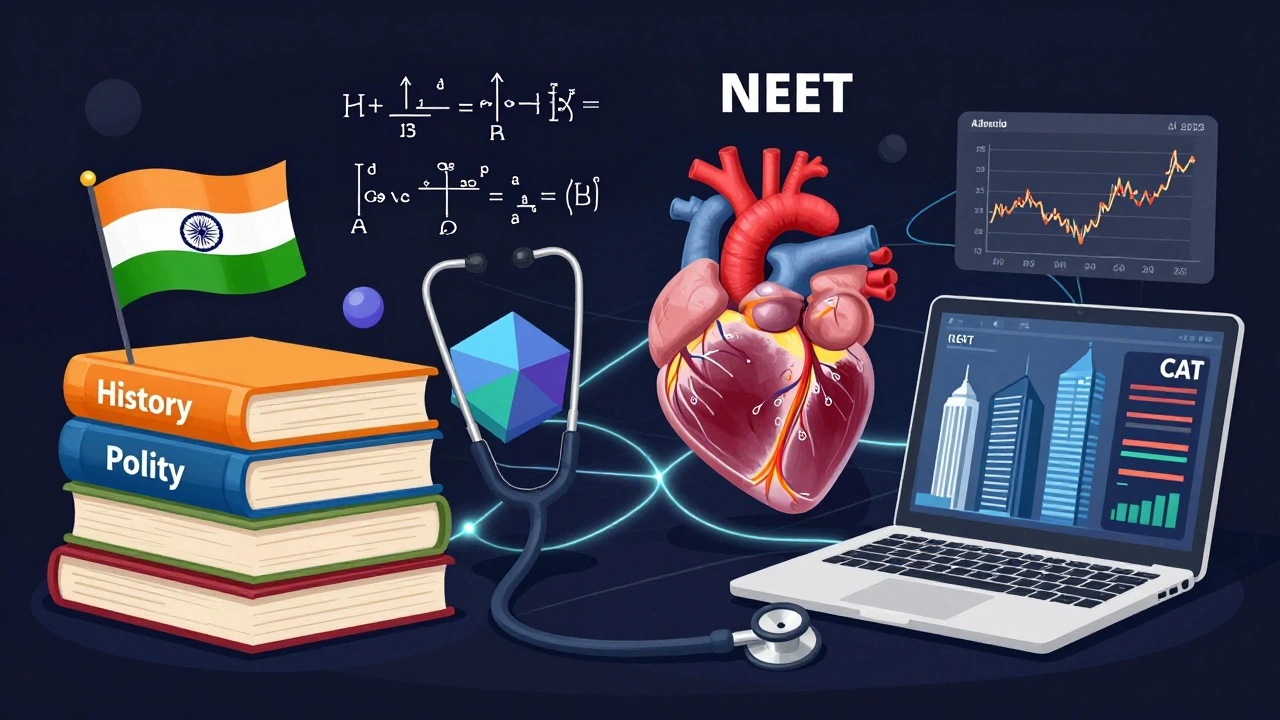
The Corporate Gateway: Common Admission Test (CAT)
While UPSC and JEE dominate the public discourse, the CAT (Common Admission Test) is the king of the corporate world. Conducted by the Indian Institutes of Management (IIMs), this exam decides who gets into the top MBA programs. The average age of a candidate is 22-24, meaning many are working professionals balancing jobs and preparation.
CAT is unique because it is adaptive and heavily penalizes wrong answers. More importantly, it tests verbal ability, data interpretation, and logical reasoning alongside quantitative aptitude. You do not need to be a math genius, but you must be accurate and fast. The real competition lies in the percentile. To get a call from the old IIMs (Ahmedabad, Bangalore, Calcutta), you typically need a 99+ percentile. With 2.5 lakh takers, only a tiny fraction achieve this score consistently.
Unlike other exams, CAT also considers your academic background, work experience, and diversity. So, even if you crack the exam, the final admission is holistic. This adds another layer of uncertainty. The pressure is different here-it is about securing a high-paying corporate job and a network that lasts a lifetime.
Other Notable Contenders
It would be remiss not to mention other exams that carry immense weight depending on the career path.
- CLAT (Common Law Admission Test): For law aspirants, CLAT is the gatekeeper to National Law Universities (NLUs). The competition is rising as law becomes a popular alternative to engineering and medicine. The focus is on legal aptitude, logical reasoning, and English comprehension.
- GATE (Graduate Aptitude Test in Engineering): Crucial for those seeking M.Tech degrees in IITs/IISc or jobs in PSUs (Public Sector Undertakings). The syllabus is highly technical and specific to each engineering branch.
- SSC CGL (Staff Selection Commission Combined Graduate Level): Often underestimated, SSC CGL recruits for Group B and C government posts. The applicant pool is massive (often exceeding 10 lakhs), and the cut-offs are extremely tight. It is a game of accuracy and speed.

How to Decide Which is "Most" Competitive for You?
Labeling one exam as the "most competitive" is subjective. Here is how you should view it:
- If you value societal impact and power: UPSC CSE is the hardest. The syllabus is endless, and the rejection rate is highest.
- If you love deep technical problem-solving: JEE Advanced is the peak. It demands intellectual rigor and years of dedicated practice.
- If you want stability and prestige in healthcare: NEET UG/PG is the battlefield. The volume of competitors is unmatched.
- If you aim for corporate leadership: CAT is the filter. It tests agility, logic, and communication under pressure.
The "difficulty" also depends on your strengths. A student great at memorization might find NEET easier than JEE. A logical thinker might breeze through CAT but struggle with UPSC's essay writing. The most competitive exam is the one that aligns with your passion, because without interest, the long hours of preparation become unbearable.
Preparing for the Battle: Key Strategies
Regardless of which exam you choose, certain principles apply to cracking the most competitive tests in India:
- Analyze Previous Year Questions (PYQs): Patterns repeat. Understanding how questions are framed is half the battle.
- Mock Tests are Non-Negotiable: You cannot prepare for these exams by reading alone. You must simulate exam conditions to build stamina and time management skills.
- Consistency Over Intensity: Studying 14 hours for a week and then burning out is useless. Consistent 6-8 hours daily for months yields better results.
- Health Matters: Sleep, diet, and exercise are not luxuries; they are performance enhancers. A tired brain makes silly mistakes.
In 2026, with digital resources and AI-driven learning tools becoming more accessible, preparation is smarter than ever. However, the core challenge remains: standing out from the crowd. Whether you are aiming for an IIT, an IIM, or the IAS, the journey is tough. But for those who persist, the reward is a career defined by excellence.
Is UPSC harder than JEE Advanced?
Yes, generally UPSC is considered harder due to its broader syllabus, lack of fixed textbooks, and multi-stage process spanning a year. JEE Advanced is technically difficult but has a defined scope and syllabus. UPSC tests general awareness and analytical writing, while JEE tests deep scientific problem-solving.
What is the success rate of NEET UG?
The overall success rate for getting any medical seat is around 5-6%. However, for government medical college seats, which are highly preferred, the success rate drops to less than 1% because there are over 20 lakh applicants for roughly 50,000-60,000 government seats.
Can I clear CAT without coaching?
Absolutely. CAT is one of the few exams where self-study is very effective. Since the syllabus is based on basic mathematics (up to Class 10 level) and language skills, disciplined self-preparation with mock tests and quality study material can lead to a top percentile score.
Which exam has the highest number of applicants?
NEET UG typically has the highest number of applicants, often exceeding 20 lakh candidates annually. SSC CGL and UPSC CSE also attract over 10 lakh applicants each, making them among the most crowded exams in India.
Is JEE Advanced only for IITs?
Primarily, yes. JEE Advanced ranks are used for admission to all 23 Indian Institutes of Technology (IITs) and seven Indian Institutes of Information Technology (IIITs), along with a few other premier institutes. It is the exclusive gateway for these top-tier engineering colleges.