




JEE First Attempt Readiness Calculator
Input Your Progress
Your Readiness Assessment
Overall Readiness Score
--
Enter your details to see your assessment
Personalized Recommendations
- Submit your data to receive tailored advice
High-Weightage Topic Tracker
Physics
Mechanics
High Weightage
Electrodynamics
High Weightage
Modern Physics
Medium Weightage
Chemistry
Inorganic (NCERT)
High Weightage
Organic Reactions
High Weightage
Physical Numericals
Medium Weightage
Mathematics
Calculus
High Weightage
Algebra
High Weightage
Coordinate Geometry
Medium Weightage
Tip: Focus on high-weightage topics first using the 80/20 rule. Master these before moving to lower-weightage areas.
Imagine sitting in the exam hall, the clock ticking down, and you realize you’ve actually prepared for this. No panic, no last-minute cramming. Just confidence. That is the dream of every student aiming for an IIT Indian Institute of Technology campus, one of India's premier engineering institutions. But let’s be honest: cracking the JEE Advanced Joint Entrance Examination Advanced, the gateway to IITs in your first attempt is not about being a genius. It is about strategy, consistency, and knowing exactly what to ignore.
Most students fail not because they lack intelligence, but because they lack direction. They buy ten different books, join three coaching classes, and end up mastering nothing. If you want to clear the JEE Main The preliminary stage of the Joint Entrance Examination conducted by NTA and then ace JEE Advanced on your first try, you need a plan that respects your time and energy. Here is how you do it without burning out.
The Foundation: Why NCERT is Non-Negotiable
Before you touch a single advanced problem from a coaching module, you need to master the basics. For Physics and Chemistry, the NCERT textbooks National Council of Educational Research and Training curriculum books used in Indian schools are your bible. In Chemistry, especially for Inorganic and Organic chemistry, questions are often directly lifted from these texts. If you can’t explain a concept using only NCERT, you aren’t ready for JEE Advanced.
- Physics: Read the theory, solve the examples, and then attempt the exercises. Focus on understanding the derivation of formulas rather than memorizing them.
- Chemistry: Treat NCERT as your primary source. Highlight important reactions and exceptions. For Physical Chemistry, practice numerical problems extensively.
- Mathematics: While NCERT provides the base, you will quickly need to move to standard reference books like RD Sharma A popular mathematics textbook series for high school students or Cengage A publisher known for its comprehensive mathematics series for competitive exams for depth.
Don’t skip chapters. The JEE syllabus is interconnected. Weakness in Trigonometry will haunt you in Calculus later. Build a strong foundation first, and everything else becomes easier.
Subject-Wise Strategy: Play to Your Strengths
Not all subjects are created equal in terms of scoring potential. You need a balanced approach, but also a smart one. Identify which subject gives you the most marks with the least effort and prioritize it.
| Subject | Key Focus Areas | Recommended Resources |
|---|---|---|
| Physics | Mechanics, Electrodynamics, Modern Physics | H.C. Verma, D.C. Pandey |
| Chemistry | Inorganic (NCERT), Organic Reactions, Physical Numericals | NCERT, O.P. Tandon, MS Chouhan |
| Mathematics | Calculus, Algebra, Coordinate Geometry | Arihant Series, Cengage, Irodov (for advanced) |
For Physics, conceptual clarity is key. Don’t just solve problems; understand why the answer is what it is. For Chemistry, speed matters. You need to recognize patterns quickly. For Mathematics, accuracy is paramount. One small calculation error can cost you a rank.
The Power of Mock Tests and Analysis
Studying hard means nothing if you can’t perform under pressure. This is where Mock Tests Simulated examinations designed to mimic the actual test environment come into play. Start taking full-length mocks at least six months before the exam. Initially, you might score low. That is normal. The goal isn’t the score; it’s the analysis.
- Take the Test: Simulate exam conditions. No phone, no breaks, strict timing.
- Analyze Errors: Categorize mistakes into three types: Silly errors, Conceptual gaps, and Unattempted questions.
- Fix Gaps: Spend more time revising topics where you had conceptual gaps. Practice similar problems to reinforce learning.
- Improve Speed: For silly errors, work on checking your work. For unattempted questions, improve your decision-making process during the test.
Keep an error log. Write down every mistake you make in a mock test and review it weekly. This simple habit can boost your score by hundreds of ranks.
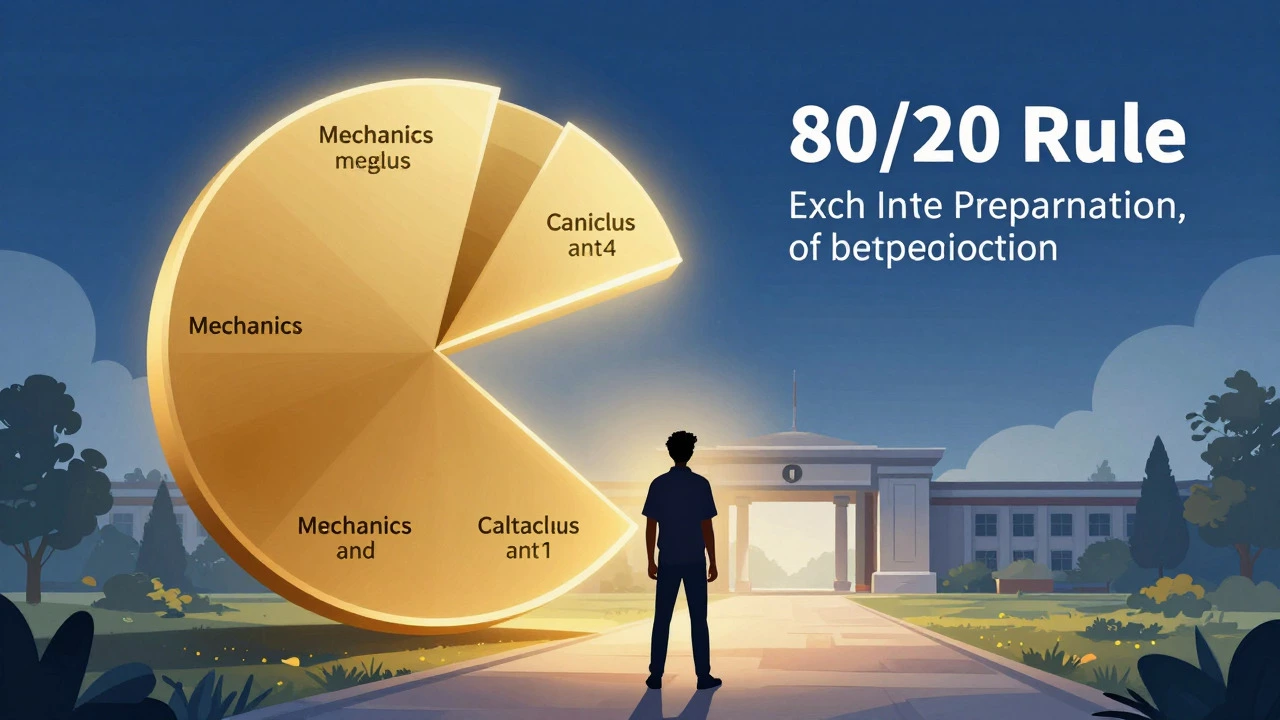
Time Management: The 80/20 Rule
You don’t have infinite time. Apply the Pareto Principle: 80% of your results come from 20% of your efforts. Identify the high-weightage topics and master them first. In JEE, certain chapters carry more weight than others.
For example, in Physics, Mechanics and Electrodynamics form a huge chunk of the paper. In Mathematics, Calculus and Algebra are dominant. Prioritize these. Once you are comfortable with these, move to lower-weightage topics. Don’t get stuck trying to perfect obscure topics that rarely appear in the exam.
Create a realistic timetable. Allocate specific hours for each subject daily. Include buffer time for revision and rest. Consistency beats intensity. Studying 6 hours every day is better than studying 14 hours once a week.
Handling Stress and Staying Healthy
Your brain needs fuel and rest to function optimally. Sleep deprivation kills productivity. Aim for 7-8 hours of sleep. Exercise regularly, even if it’s just a 30-minute walk. Meditation can help reduce anxiety and improve focus.
Avoid comparing yourself with peers. Everyone has their own pace. Focus on your progress. Celebrate small victories. Did you solve a tough problem? Good. Did you improve your mock test score? Great. Keep moving forward.
If you feel overwhelmed, take a break. Burnout is real. A fresh mind solves problems faster than a tired one. Remember, this is a marathon, not a sprint.
Common Pitfalls to Avoid
Many students fall into traps that derail their preparation. Avoid these common mistakes:
- Collecting too many resources: Stick to one or two books per subject. Master them completely.
- Ignoring previous year papers: Solve at least the last 10 years of JEE Main and Advanced papers. Understand the pattern and difficulty level.
- Neglecting weak areas: Don’t just practice what you know. Face your weaknesses head-on.
- Procrastination: Start early. Last-minute preparation leads to stress and poor performance.
Stay disciplined. Motivation fades, but discipline keeps you going. Create a system that works for you and stick to it.
Final Months: Revision and Confidence Building
In the last two months before the exam, stop learning new concepts. Focus entirely on revision. Go through your notes, error logs, and formula sheets. Take regular mock tests to maintain momentum.
Build your confidence. Visualize success. Believe in your preparation. You have put in the hard work. Now, trust the process. Enter the exam hall with a calm mind and a clear strategy. You are ready.
Is it possible to crack IIT JEE in one year?
Yes, it is possible if you are dedicated and follow a structured plan. You need to cover the entire syllabus, practice extensively, and take regular mock tests. However, it requires intense focus and consistent effort throughout the year.
Which subjects should I prioritize for JEE?
Prioritize based on your strength and the weightage of topics. Generally, Mechanics in Physics, Calculus in Mathematics, and Inorganic Chemistry are high-yield areas. However, a balanced approach across all three subjects is essential for a good rank.
How many hours should I study daily?
Quality matters more than quantity. Aim for 6-8 hours of focused study daily. Ensure you include time for revision, practice, and rest. Consistent daily study is more effective than erratic long sessions.
Should I join a coaching institute?
Coaching can provide structure and resources, but it is not mandatory. Many students succeed through self-study. If you join coaching, ensure you complement it with self-practice and mock tests. Self-discipline is key regardless of your choice.
What is the importance of NCERT books?
NCERT books are crucial, especially for Chemistry and basic concepts in Physics and Mathematics. They provide a solid foundation and are often the source of direct questions in JEE Main. Mastering NCERT is essential before moving to advanced materials.