


College Course Difficulty Estimator
Configure Course Parameters
5 hrs
15 hrs
60 hrs
Adjust the parameters and click "Estimate Difficulty" to see how this course compares to others mentioned in the article.
You walk into a lecture hall at Massachusetts Institute of Technology (MIT) or sit down for a final exam at Harvard University, and you might wonder: what is actually the hardest class in America? There isn’t one single answer. If you ask an engineering student, they’ll point to a physics problem set that took them three days to solve. If you ask a law student, they’ll talk about the sheer volume of case briefs required for Constitutional Law. The "hardest" class depends entirely on your brain’s wiring, your background, and the specific culture of the university.
In the United States, higher education is decentralized. Unlike countries with national standardized curricula, every university sets its own grading curves, syllabus depth, and pass rates. This means a Calculus III course at a small liberal arts college might be a breeze compared to the same course number at a research-intensive university like Stanford University. To find the true "hardest" classes, we have to look at data from student reviews, historical drop-out rates, and the reputation of specific departments known for academic brutality.
The Undisputed Kings of Difficulty: Engineering and Physics
When people discuss the most grueling academic experiences in American universities, the conversation almost always starts with engineering. Specifically, the core curriculum for electrical and chemical engineering programs. These fields require a mastery of advanced mathematics and abstract physical principles simultaneously.
Take Thermodynamics in Chemical Engineering. It’s not just about memorizing formulas; it’s about understanding energy transfer at a molecular level while applying complex differential equations. Students often report spending 40 to 60 hours a week on this single course. The difficulty comes from the abstraction. You can’t see heat entropy. You have to visualize it through math.
Then there is Quantum Mechanics in Physics departments. At top-tier schools like California Institute of Technology (Caltech), this course is legendary. It challenges everything you know about reality. Particles exist in multiple states until observed. The math involves linear algebra and complex analysis that feels alien to students coming from high school calculus. The curve here is notoriously steep, with average grades often hovering around a C- or D+, simply because the material is designed to weed out those who aren’t destined for theoretical physics careers.
| Course Name | Primary Discipline | Key Challenge | Typical Weekly Hours |
|---|---|---|---|
| Organic Chemistry II | Chemistry | Complex reaction mechanisms & spatial reasoning | 15-20 hours |
| Fluid Dynamics | Mechanical Engineering | Advanced vector calculus application | 20-25 hours |
| Real Analysis | Mathematics | Rigorous proof writing & logic | 18-22 hours |
| Neuroscience I | Biology/Psychology | Vast volume of memorization + systems thinking | 15-18 hours |
The "Weeder" Classes: Organic Chemistry and Biology
If engineering is hard because of the math, pre-med tracks are hard because of the volume and precision. Organic Chemistry is famously known as the "weeder" class. Its primary purpose in many university curricula is to separate students who are truly committed to medical school from those who are just curious.
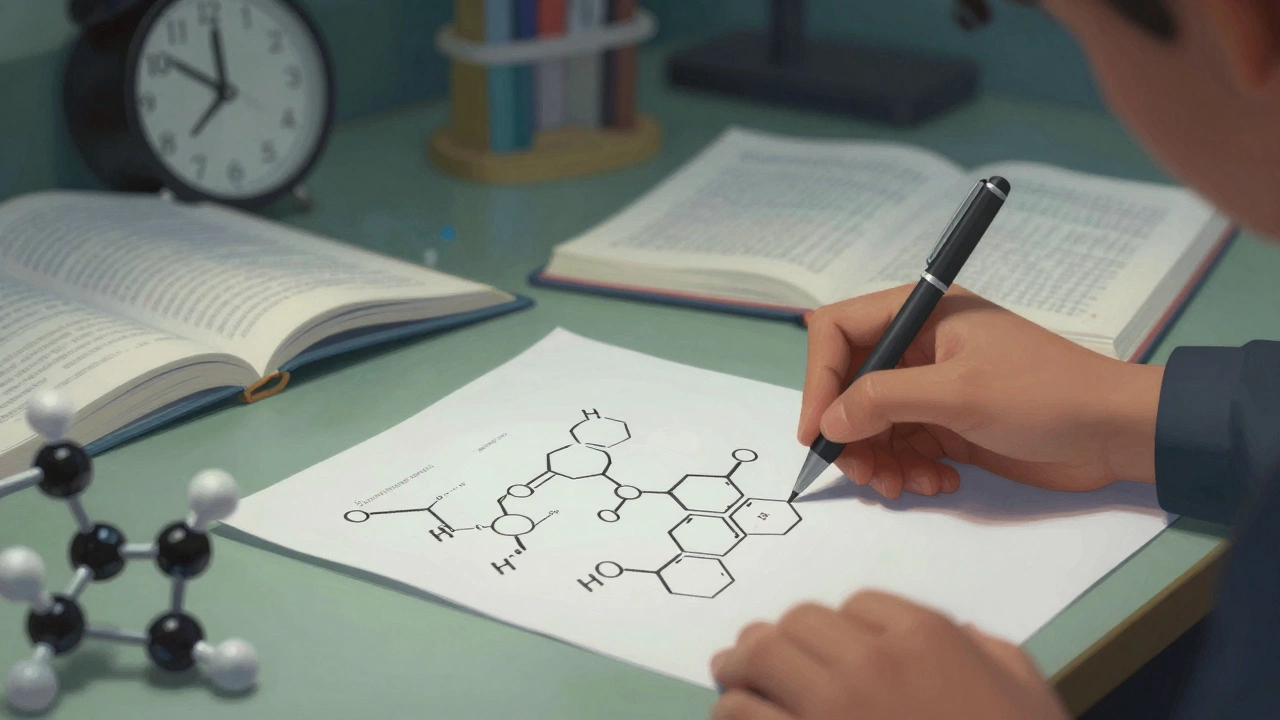
Why is it so tough? It requires a complete shift in how you think. In general chemistry, you balance equations. In organic chemistry, you must visualize molecules rotating in 3D space and predict how electrons will move during reactions. One wrong step in a reaction mechanism means the entire answer is wrong. There is no partial credit for "close enough." At large state universities like University of Michigan or University of California, Los Angeles (UCLA), these classes can have hundreds of students, making it difficult to get individual help when you’re stuck.
Biology majors face their own beast: Cell Biology or Genetics. These courses demand rote memorization of thousands of terms, pathways, and processes. But unlike history, where context helps memory, biology requires precise recall. Confusing a kinase with a phosphatase can cost you points on a final exam that determines your GPA.
Humanities and Law: The Hidden Grind
We often forget that non-STEM fields have incredibly difficult courses too. The difficulty here isn’t about finding the "right" numerical answer; it’s about constructing irrefutable arguments under extreme time pressure.
At Yale Law School or Columbia Law School, first-year Contracts and Torts are brutal. Professors use the Socratic method, calling on random students to dissect complex legal cases they read the night before. If you don’t know the holding of a 19th-century case, you’re exposed in front of 200 peers. The mental stamina required to stay sharp for two-hour lectures, six days a week, is exhausting.
In undergraduate humanities, Philosophy courses like Ethics or Metaphysics at rigorous schools like Princeton University challenge students to deconstruct fundamental assumptions about existence. The difficulty lies in the ambiguity. There is no textbook answer key. Your grade depends on the clarity, originality, and logical consistency of your essays. For students used to clear-cut right/wrong answers, this subjective rigor can be more stressful than calculus.
Language and Performance: The Precision Trap
Learning a new language at an advanced level is harder than most people realize. Mandarin Chinese or Arabic at the 300-level or above are considered some of the hardest language classes in America. These languages have different writing systems, tonal structures (in Mandarin), and grammatical rules that don’t map onto English.
At Georgetown University, which has a strong focus on international affairs, upper-level language courses require near-native fluency in reading classical texts or conversing without hesitation. The margin for error is zero. Mispronouncing a tone in Mandarin changes the meaning of the word entirely. This requires thousands of hours of practice, not just classroom time.
Similarly, performing arts students face unique pressures. A Music Theory or Counterpoint class at Juilliard combines intellectual rigor with physical performance. You must understand complex harmonic structures while simultaneously playing an instrument flawlessly. The stress of public performance adds a layer of anxiety that written exams in other subjects simply don’t have.
Factors That Make a Class "Hard"
To understand why certain classes are labeled the hardest, we need to break down the components of academic difficulty. It’s rarely just one thing.
- Grading Curves: Some professors enforce a strict bell curve. Even if you score 90% on every test, if everyone else scores 95%, you might get a B-. This creates a zero-sum game environment that increases stress.
- Workload Volume: Classes that require 10+ hours of homework per credit hour are physically draining. Engineering labs combined with heavy reading loads leave little time for sleep.
- Abstractness: Subjects that deal with invisible concepts (quantum physics, pure mathematics) are harder for many brains to grasp than tangible subjects (anatomy, history).
- High Stakes: If failing the class means losing your scholarship, delaying graduation, or ruining your chances for med school, the psychological weight makes the material feel harder.

How to Survive the Hardest Classes
If you’re facing one of these notorious courses, panic won’t help. Here is how top students manage the load.
- Start Early: Don’t wait until the night before. In Organic Chemistry, reviewing notes daily prevents the "wall" effect where you suddenly don’t understand anything.
- Form Study Groups: Explaining a concept to someone else is the best way to learn it. In Calculus and Physics, group problem-solving sessions are essential.
- Office Hours: Go to professor office hours early in the semester. Build a relationship. They are more likely to give you helpful hints on exams if they know you’re trying.
- Focus on Concepts, Not Memorization: In subjects like Thermodynamics, memorizing formulas fails you when the problem is tweaked. Understand the underlying principle.
- Prioritize Sleep: It sounds cliché, but your brain consolidates learning during sleep. Pulling all-nighters reduces your ability to solve complex problems by up to 30%.
Conclusion: It’s Subjective, But Data Helps
So, what is the hardest class in America? If you look at raw failure rates and student complaints, Organic Chemistry and Engineering Physics consistently rank at the top. However, for a writer, Creative Writing Workshop might be the hardest due to emotional vulnerability. For a debater, Logic might be the most frustrating.
The "hardest" class is the one that challenges your weakest skills. Recognizing this allows you to prepare better. Whether you are preparing for competitive exams like the MCAT, LSAT, or GRE, understanding the nature of academic difficulty helps you build resilience. The goal isn’t just to survive the class, but to master the skill set it teaches.
What is the hardest major in college in the US?
Engineering, particularly Electrical and Chemical Engineering, is widely considered the hardest major due to the combination of advanced mathematics, physics, and lab work. Architecture and Nursing also rank highly due to long hours and rigorous practical requirements.
Is Organic Chemistry really the hardest class?
For pre-med students, yes. It has high failure rates and requires significant time commitment. However, for students strong in spatial reasoning and logic, it may be easier than abstract mathematics or philosophy. Its reputation as a "weeder" class contributes to its perceived difficulty.
Which university has the hardest classes?
Universities like MIT, Caltech, and Stanford are known for rigorous academics. However, difficulty varies by department. A humanities course at Harvard might be less quantitatively demanding than an engineering course at a state university, but the expectations for critical thinking remain high everywhere.
How do I prepare for difficult college courses?
Review prerequisite material before the semester starts. Form study groups early. Attend office hours regularly. Focus on understanding concepts rather than rote memorization. Manage your time strictly to avoid cramming.
Are online classes harder than in-person classes?
Online classes often require more self-discipline and time management, which can make them feel harder for some students. However, the academic content and grading standards should be equivalent to in-person courses at accredited institutions.