Dubai vs India Education: Which System Is Better for Students?
Compare Dubai's modern, international schools with India's massive, diverse system. Learn about curriculum, cost, quality and global pathways to decide which education fits your goals.
When you think about education comparison, the process of evaluating how learning systems differ across countries, institutions, or pathways. Also known as systematic educational analysis, it's not just about rankings—it's about what actually works for real students. India’s system isn’t just different from the US or Europe—it’s built for a different kind of pressure. While American schools focus on creativity and choice, Indian schools train you to win high-stakes exams with near-zero room for error. That’s not a flaw. It’s a design.
Take CBSE, India’s largest school board, with over 20 million students and growing global reach. It’s not popular because it’s the most fun—it’s popular because it’s predictable. The syllabus aligns directly with JEE, NEET, and UPSC, so students who master CBSE are already prepped for the next big hurdle. Compare that to ICSE, a board known for broader curriculum and deeper English focus. ICSE students often write better essays, but they spend less time drilling multiple-choice patterns. Which one gives you the edge? It depends on whether your goal is an IIT seat or a scholarship abroad.
Then there’s the vocational vs academic education, the split between skill-based training and theory-heavy degrees. In Germany, 60% of teens choose vocational paths. In India, that number is under 10%. Why? Because society still sees a degree as the only ticket to respect. But that’s changing. More parents are asking: Is a four-year BA worth it if your kid can learn coding in three months and land a job? The answer isn’t one-size-fits-all. Some need the structure of an MBA. Others need a welding certificate. The real question isn’t which path is better—it’s which one fits your life.
And then there are the exams. Education comparison isn’t just about boards or degrees—it’s about the tests that decide futures. The Gaokao in China, the USMLE in America, the UPSC in India—they’re all brutal, but for different reasons. One tests memory. One tests clinical judgment. One tests endurance over years. You can’t compare them on difficulty alone. You have to ask: What kind of person does each system reward? The answer tells you more about the country than the curriculum ever could.
What you’ll find below isn’t a list of opinions. It’s a collection of real stories, data, and breakdowns from students who’ve walked these paths. From the exact percentile needed for an NIT to whether an MBA after 30 still pays off, every post here answers a question someone actually asked. No fluff. No theory. Just what works—and what doesn’t—when you’re trying to build a future in India’s crowded, competitive, and constantly shifting education landscape.
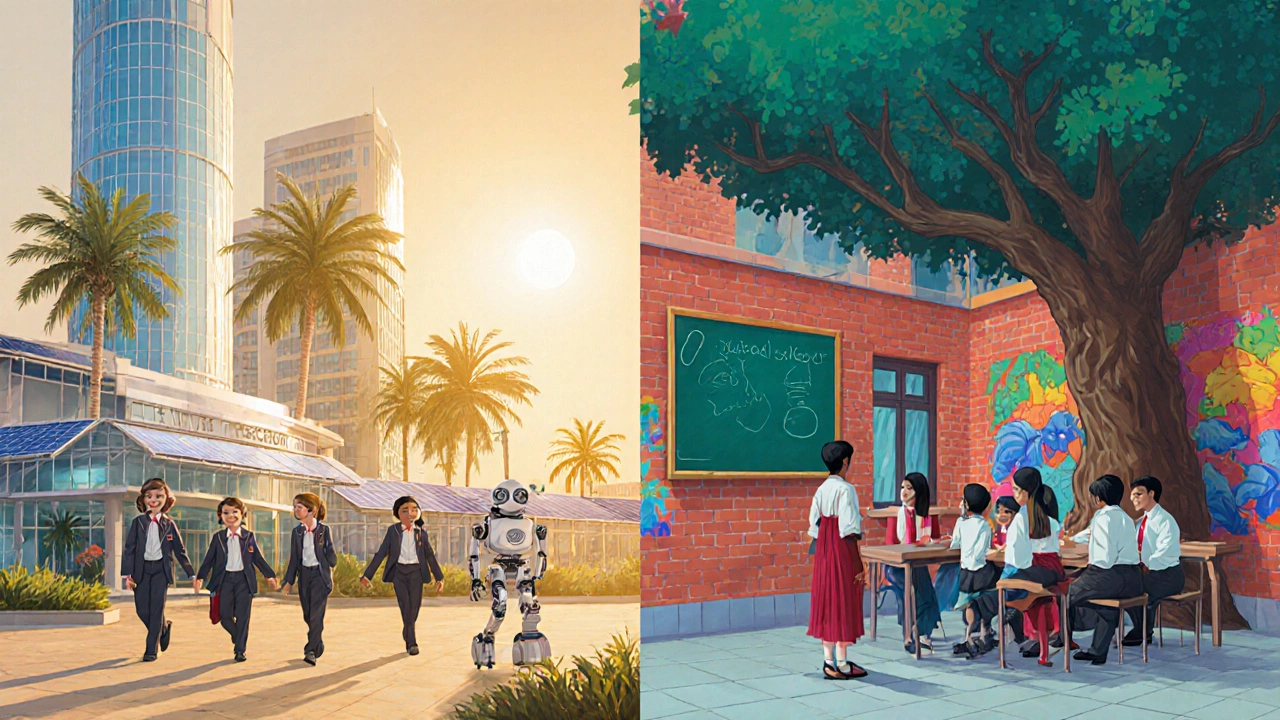
Compare Dubai's modern, international schools with India's massive, diverse system. Learn about curriculum, cost, quality and global pathways to decide which education fits your goals.

Get expert insights, comparisons, and real-world advice on choosing the best country for studying abroad in 2025. Weigh costs, visas, careers, and life in top destinations.