
Find Your Best-Fit Education Board
Answer 3 Questions to Get Your Recommendation
1. What is your primary career goal?
🎯
Competitive Exams
JEE, NEET, Engineering/Medical
JEE, NEET, Engineering/Medical
🌍
Study Abroad
Universities in UK, USA, Canada
Universities in UK, USA, Canada
📚
Holistic Foundation
Arts, Humanities, Strong English
Arts, Humanities, Strong English
🏠
Local Stability
State Govt Jobs, Local Colleges
State Govt Jobs, Local Colleges
2. How do you prefer to learn?
⚡
Direct & Structured
Clear formulas, direct questions, predictable patterns
Clear formulas, direct questions, predictable patterns
🧠
Deep & Analytical
Essay writing, critical thinking, detailed analysis
Essay writing, critical thinking, detailed analysis
🔬
Project-Based
Research, internal assessments, independent work
Research, internal assessments, independent work
🔄
Flexible & Accessible
Bilingual support, less rigorous pressure
Bilingual support, less rigorous pressure
3. What is your budget constraint?
Low Cost
Government schools, affordable fees
Moderate
Private schools, standard fees
High Budget
Premium private/international schools
Recommended Board:
Why this fits you:
Match Analysis
Board Profile
💡 Pro Tip
You hear it everywhere: "CBSE is easier." "ICSE is too hard." "State boards are a walk in the park." If you are a parent trying to choose a school for your child or a student wondering which path offers the least resistance, these claims can be confusing. The truth is not black and white. There is no single "easiest" board in India because difficulty depends entirely on what you value: rote memorization, conceptual depth, or English proficiency.
However, if we define "easy" as having a predictable exam pattern, widely available study materials, and a curriculum that aligns directly with competitive entrance exams like JEE and NEET, CBSE often takes the crown. But "easy" does not always mean "better." Let’s break down the major boards-CBSE, ICSE, State Boards, and IB-to see where they actually stand.
The Case for CBSE: Predictability and Alignment
Central Board of Secondary Education (CBSE) is
India's largest national education board, known for its standardized curriculum and alignment with national competitive exams.
It operates under the Ministry of Education and serves over 30 million students across thousands of schools. Its primary strength lies in its consistency. Every year, the exam pattern remains largely unchanged. Questions are direct, and the marking scheme is transparent.
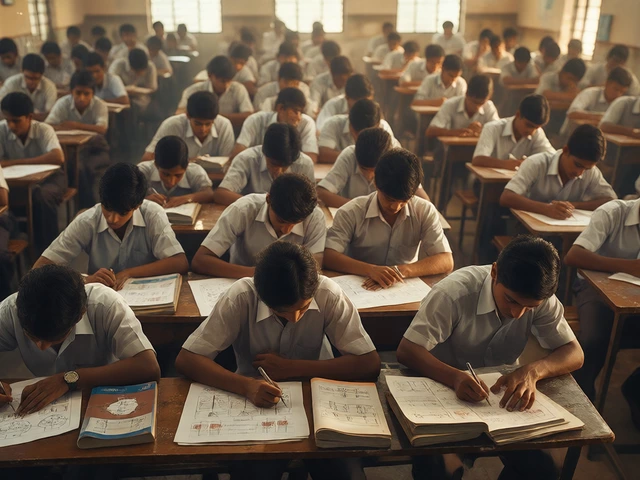
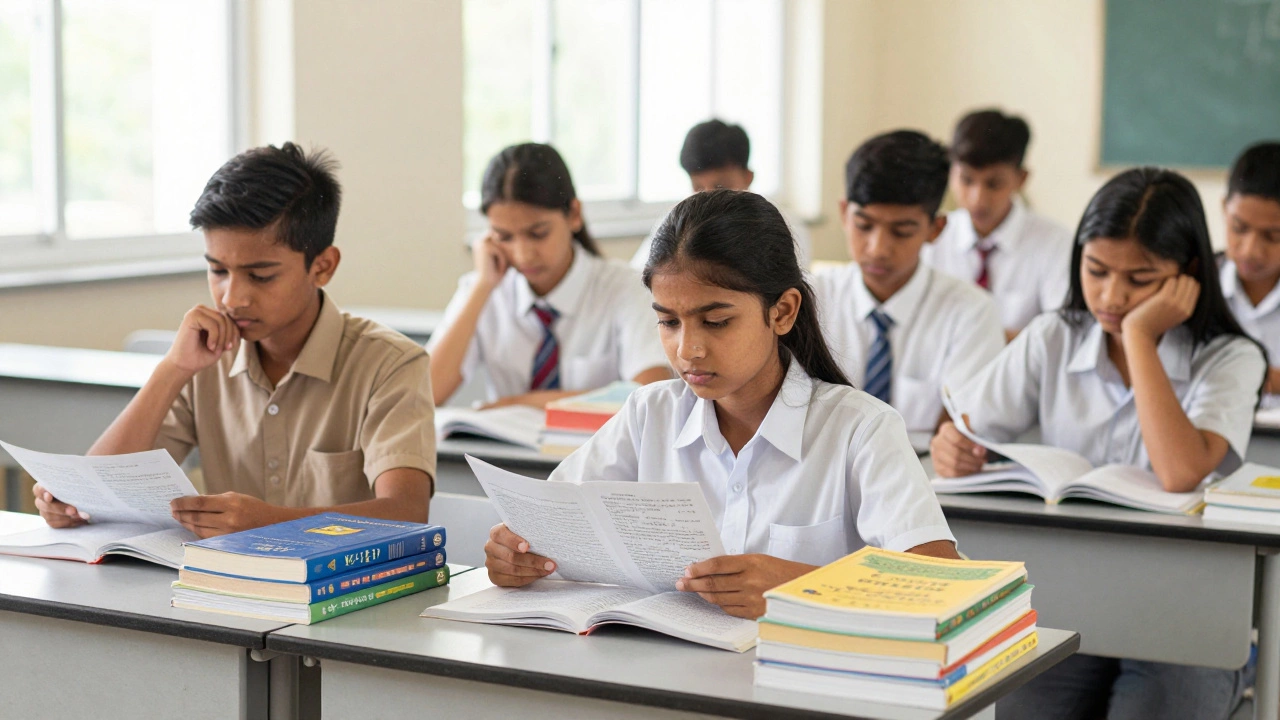
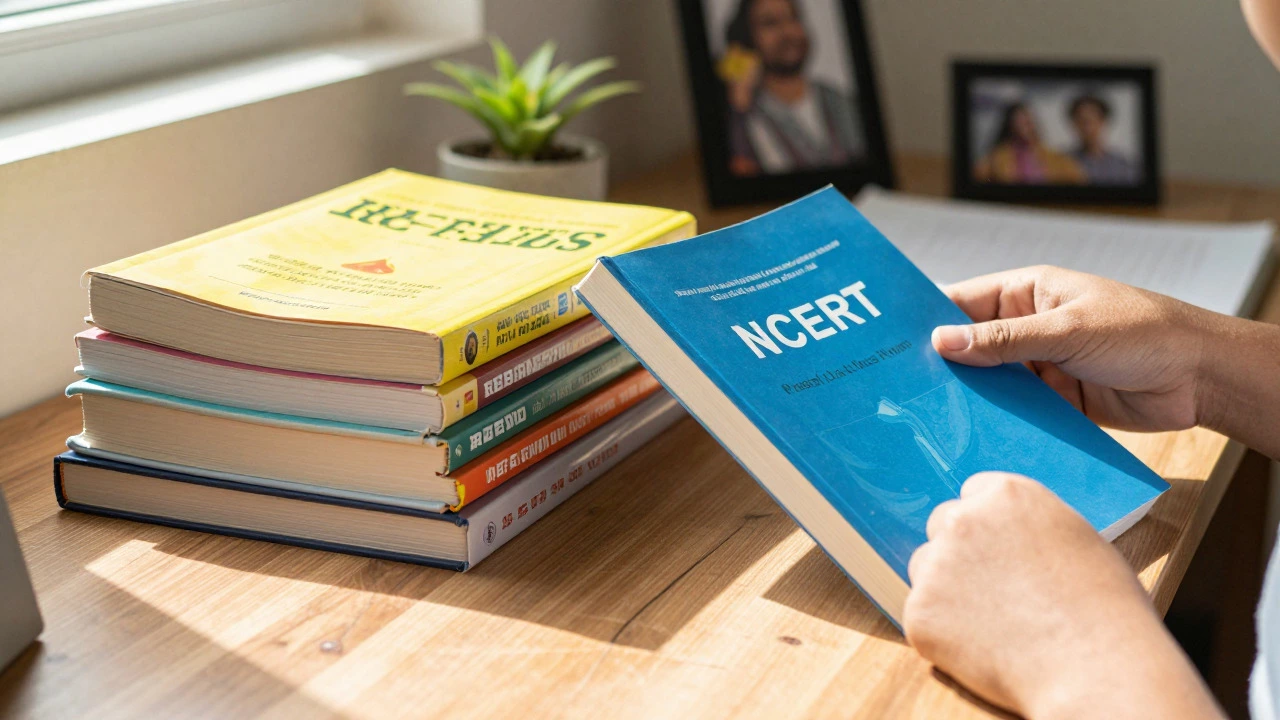
Why do people call CBSE easy? Because it rewards precision. In subjects like Mathematics and Science, if you know the formula and apply it correctly, you get the marks. You don’t need to write long, essay-style answers. This makes preparation straightforward. Students can rely on previous years’ question papers and standard textbooks like NCERT. If you master NCERT, you have covered 90% of the board exam syllabus.
Furthermore, CBSE is designed with engineering and medical aspirants in mind. The physics, chemistry, and biology content mirrors the early stages of IIT JEE and NEET preparation. For a student aiming for these goals, CBSE feels "easier" because their board prep doubles as entrance exam prep. There is less context switching required.
- Exam Pattern: Objective and short-answer focused; minimal subjective interpretation.
- Study Material: NCERT books are sufficient for high scores.
- Language: Simple English; less emphasis on literary flair.
- Best For: Students targeting JEE, NEET, or government jobs.
The ICSE Challenge: Depth Over Speed
Indian Certificate of Secondary Education (ICSE) is
A private board administered by CISCE, renowned for its rigorous English language focus and detailed, comprehensive curriculum.
Known for producing students with strong communication skills, ICSE requires deep understanding rather than surface-level memorization.
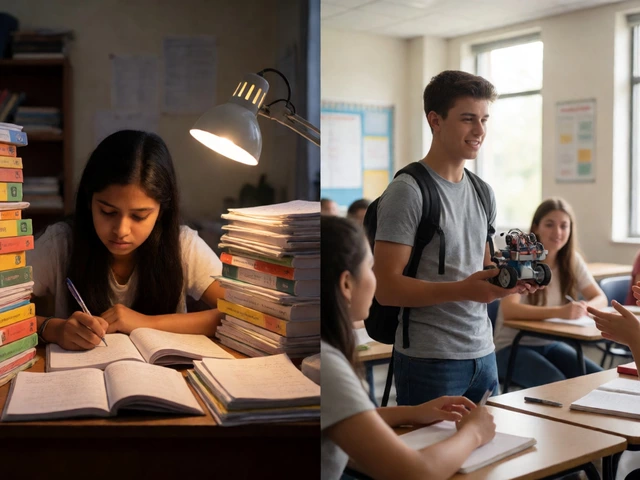
If CBSE is about speed and accuracy, ICSE is about detail and expression. Many students find ICSE harder because the questions are rarely direct. In English Literature, you aren’t just asked to summarize a poem; you’re asked to analyze the poet’s mood, use of imagery, and historical context. In History, you need to connect events across decades, not just list dates.
The workload is also heavier. ICSE students often juggle more subjects with equal weightage. You can’t ignore Geography or Civics even if you love Math. The board expects a well-rounded student. This holistic approach builds strong foundational knowledge but comes at the cost of higher stress levels during exams.
Is it "harder"? Yes, if you dislike writing long answers. No, if you enjoy exploring topics deeply. ICSE graduates often adapt better to international universities because their English proficiency and critical thinking skills are sharper from day one.
- Exam Pattern: Subjective, descriptive, and analytical.
- Study Material: Requires multiple reference books beyond the prescribed text.
- Language: High emphasis on grammar, vocabulary, and literature.
- Best For: Students aiming for liberal arts, humanities, or foreign universities.
State Boards: The Local Advantage
India has dozens of state boards (like Maharashtra State Board, UP Board, Tamil Nadu State Board). Each is governed by its respective state government. These boards are often labeled as the "easiest" because the competition is localized. You are competing against students from your district, not the entire country.
The syllabus is usually simpler and less exhaustive than CBSE or ICSE. The language of instruction is often bilingual (English + local language), which helps students who struggle with pure English mediums. Pass rates in many state boards are significantly higher, sometimes exceeding 85-90%, compared to CBSE’s fluctuating averages.
However, "easy" here has a catch. The quality of education varies wildly depending on the school. A top-tier state board school might offer excellent resources, while a rural one might lack basic labs. Additionally, if you plan to move out of your state for college, you might face a curriculum gap. State board students often need extra coaching to bridge the difference when preparing for national-level exams like JEE or CUET.
- Exam Pattern: Varies by state; generally less rigorous than national boards.
- Study Material: State-specific textbooks; limited external resources.
- Language: Flexible; often includes regional languages.
- Best For: Students planning to stay within their home state for higher education.
International Boards: IB and IGCSE
International Baccalaureate (IB) is
A globally recognized curriculum emphasizing inquiry-based learning, critical thinking, and international-mindedness.
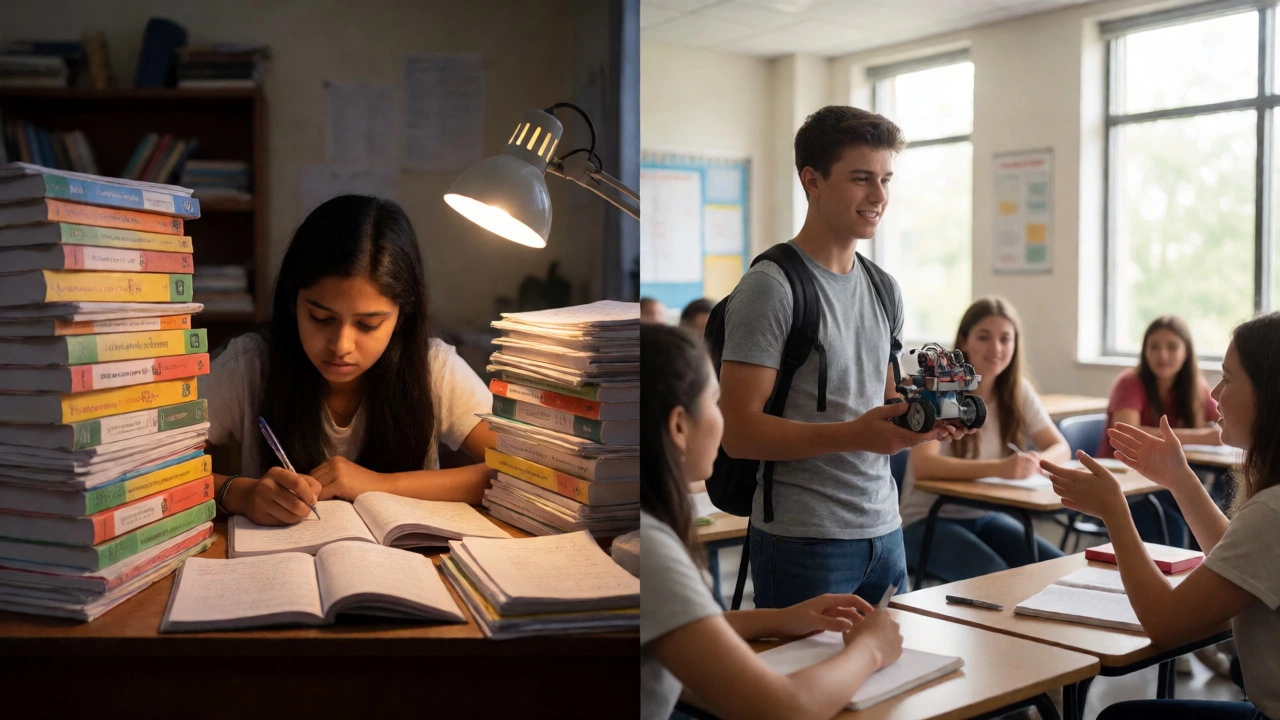
Unlike traditional boards, IB focuses on the process of learning rather than just the outcome, requiring students to complete extensive projects and essays.
If you think CBSE is easy, try the International Baccalaureate (IB) or Cambridge IGCSE. These boards are not "easy" in any traditional sense. They demand independent research, internal assessments, and a thick skin for feedback. An IB Diploma student must write a 4,000-word extended essay, complete a community service project, and study six subjects simultaneously.
However, they are "easier" in terms of exam pressure. Your final grade isn’t determined by one stressful week of exams. Continuous assessment counts for a significant portion of your mark. If you are a self-starter who hates cramming, IB might feel more manageable. But if you prefer clear instructions and defined boundaries, IB will feel chaotic and overwhelming.
Comparison Table: Which Board Fits You?
| Feature | CBSE | ICSE | State Boards | IB/IGCSE |
|---|---|---|---|---|
| Difficulty Level | Moderate | High | Low to Moderate | Very High |
| Focus Area | Science & Math | English & Humanities | Local Context | Global Perspective |
| Exam Style | Direct & Formulaic | Descriptive & Analytical | Variable | Project-Based & Internal |
| Competitive Edge | JEE/NEET Alignment | Communication Skills | State Govt Jobs | Foreign Admissions |
| Cost | Moderate | High | Low | Very High |

How to Choose: It’s Not Just About Ease
Picking the "easiest" board is a trap. You might pass Class 12 with flying colors, only to struggle in college because your foundation was weak. Instead, ask yourself three questions:
- Where do you want to study? If you aim for IITs or AIIMS, CBSE is the logical choice. If you look toward UK or US universities, ICSE or IB gives you an edge.
- What is your learning style? Do you like clear rules and formulas? Go CBSE. Do you love reading, debating, and writing? Choose ICSE.
- What is your budget? International boards and top ICSE schools are expensive. State boards and government CBSE schools are affordable.
Remember, the board is just a framework. A motivated student can excel in any system. A distracted student will struggle in all of them. The "easiest" board is the one that matches your strengths and future goals.
Common Misconceptions About Board Difficulty
There is a myth that ICSE students are smarter than CBSE students. This is false. ICSE tests depth; CBSE tests breadth and speed. Another myth is that State Boards are "low quality." While some are, many state board toppers crack IITs every year through sheer hard work and self-study. The board doesn’t determine your intelligence; your effort does.
Also, don’t confuse "passing easily" with "learning effectively." You might pass a State Board exam with minimal effort, but if you lack conceptual clarity, you will hit a wall in professional courses like Engineering or Medicine. CBSE strikes a balance, but it still requires consistent study habits.
Is CBSE really the easiest board in India?
For most students aiming for science and commerce streams, yes. CBSE offers a predictable exam pattern, direct questions, and ample study resources. However, "easy" is relative. If you struggle with math and science, even CBSE can feel difficult. For arts students, ICSE might feel more natural due to its descriptive nature.
Which board is best for engineering entrance exams?
CBSE is widely considered the best for JEE Main and Advanced preparation because its syllabus overlaps significantly with the competitive exam curriculum. This reduces the need for separate board-focused studies.
Can I switch from CBSE to ICSE in higher classes?
Technically, yes, but it is challenging. ICSE has a deeper syllabus, especially in English and Social Studies. Switching late means you’ll have to catch up on years of detailed content. It’s better to decide before Class 9.
Are State Boards accepted by top colleges?
Yes. Top colleges like IITs, NITs, and central universities accept students from all recognized boards. Admission is based on entrance exam scores (JEE, NEET, CUET), not your board name. However, you may need extra coaching to bridge the syllabus gap.
Which board is better for studying abroad?
IB and IGCSE are the most recognized globally. ICSE is also well-regarded for its strong English component. CBSE is accepted, but you may need to take additional tests like SAT or IELTS to prove your readiness for international universities.