



Degree Difficulty Comparison Tool
Compare the toughest paths in Indian education
This tool helps you compare the key challenges of top degrees based on real student experiences. See which path matches your strengths and tolerance for pressure.
Important note
The most difficult path depends on your personal strengths and circumstances. While CA is often considered the toughest due to its relentless nature, some students thrive in its structured challenge.
What makes a degree challenging?
Every degree has different demands. This tool breaks down the key factors that make these paths difficult:
- Study Volume & Memorization High
- Competition Level High
- Emotional Pressure High
- Work-Life Balance Low
- Second Chance Options Limited
How to use this tool
Compare the key aspects of each degree:
- Click on any degree name to see detailed challenges
- Review the difficulty indicators (1-5 scale)
- Consider which factors matter most to you
- Reflect on your strengths and limitations
Remember: Difficulty is subjective. Some students thrive in the structured intensity of CA, while others struggle with the constant pressure.
Degree Comparison Chart
| Category | Engineering (IIT JEE) | Medicine (NEET) | Chartered Accountancy | Architecture | Law (CLAT) |
|---|---|---|---|---|---|
| Entrance Exam Pressure | 4 | 4 | 5 | 3 | 3 |
| Study Volume | 4 | 5 | 4 | 3 | 4 |
| Pass Rate | 2-3% (Advanced) | ~4% (Top Institutes) | ~15% (Final) | ~70% (Overall) | ~20-30% (Top Institutes) |
| Work-Life Balance | 3 | 2 | 1 | 2 | 3 |
| Second Chance Options | 2 | 1 | 5 | 2 | 2 |
| Emotional Pressure | 4 | 4 | 5 | 4 | 3 |
| CBSE Syllabus Alignment | Excellent | Excellent | Good | Fair | Good |
Detailed Breakdown
Engineering (IIT JEE)
Over 1.5 million students take JEE Main annually. Only 10,000 make it to top IITs. The curriculum requires solving 150+ numericals daily for 2 years. Precision is critical—no partial credit for errors. IITs have a 15-20% dropout rate in the first year.
Students often study 8-10 hours daily for 2+ years, with 4-5 hours of sleep. The system is designed to overwhelm you.
When you’re a CBSE student in Class 11 or 12, everyone asks: What do you want to study? Engineering? Medicine? Law? The answer isn’t just about passion-it’s about endurance. India’s education system doesn’t just test knowledge; it tests how long you can keep going when sleep is a luxury, weekends are gone, and your self-worth feels tied to a rank number.
There’s no official government list of the toughest degrees. But if you talk to students who’ve lived through them, the pattern is clear. Some paths aren’t just hard-they’re designed to filter out everyone except the most relentless.
Engineering: The IIT JEE Gauntlet
Let’s start with the one everyone knows: engineering, especially at IITs. Over 1.5 million students take JEE Main every year. Only 10,000 make it into the top 7 IITs. The syllabus? Physics, Chemistry, and Math at a level that goes far beyond CBSE Class 12. You don’t just learn formulas-you memorize 50 variations of a single integration problem. You solve 150+ numericals a day. You train for 8-10 hours daily, often for two full years.
What makes it brutal isn’t just the volume. It’s the precision. One misread sign in a mechanics problem, one decimal error in a thermodynamics calculation, and your rank drops 5,000 spots. There’s no partial credit. No mercy. You’re competing against 1.5 million others who are equally obsessed.
And the pressure doesn’t stop at admission. IITs have a 15-20% dropout rate in the first year. The curriculum is designed to overwhelm. Students report 16-hour days during exams. Sleep? Maybe 4-5 hours. Weekends? Used for mock tests, not relaxation.
Medicine: NEET and the 12,000-Hour Marathon
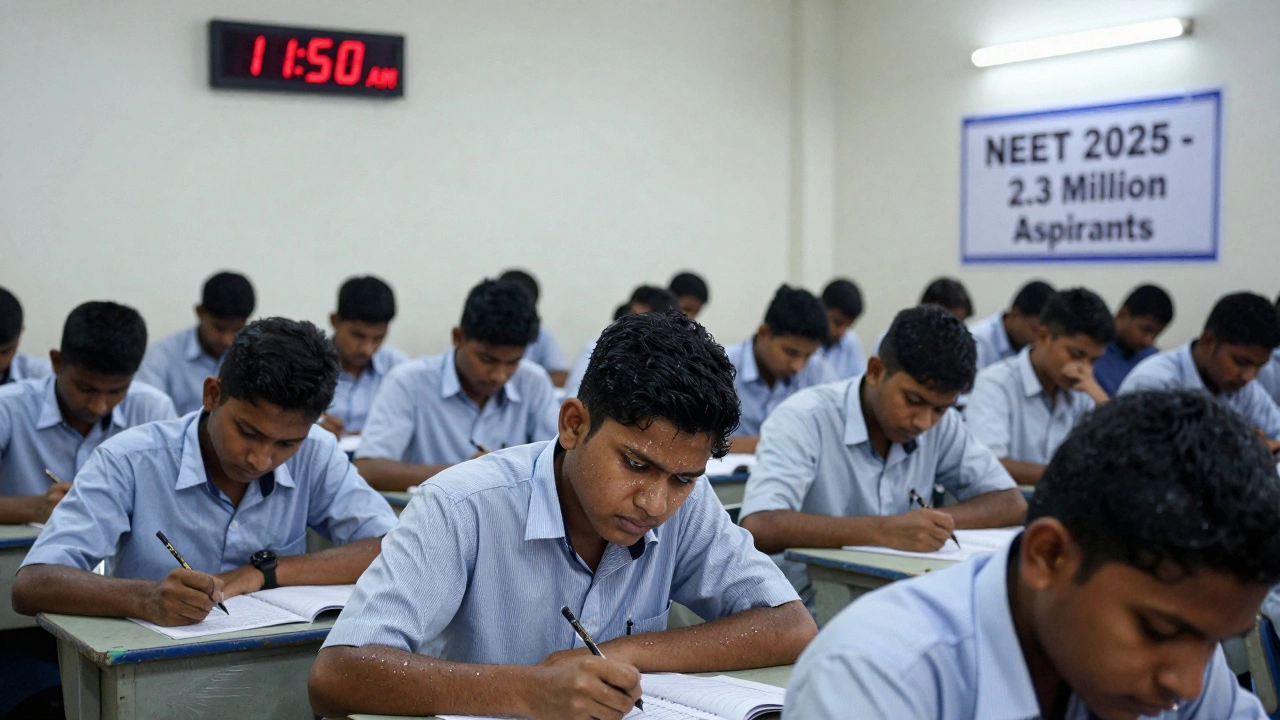
If engineering feels like a sprint with weights, medicine is a marathon with no finish line in sight. NEET is the gatekeeper. Over 2.3 million students sit for it every year. Only 100,000 get seats in MBBS programs. And even then, you’re not done.
The CBSE syllabus for biology is dense. But NEET doesn’t stop at NCERT. You need to know every organelle, every enzyme pathway, every drug interaction. You memorize 700+ drug names and their side effects. You learn anatomy by labeling 300+ structures on a diagram. You spend hours with 3D models of the human brain, trying to memorize which nerve controls which eyelid movement.
Once you’re in, it gets worse. The first year alone has 14 subjects. Anatomy, Physiology, Biochemistry, Pharmacology, Microbiology, Forensic Medicine-you’re tested on all of them in the same week. One student from Delhi told me: "I studied 18 hours on my birthday. My mom cried. I didn’t even notice."
And there’s no escape. You can’t take a gap year. You can’t switch majors. You’re locked in for 5.5 years. Plus, the clinical rotations start early. You’re handling real patients while still learning how to tie a tourniquet.
Chartered Accountancy: The Silent Beast
Most people don’t realize CA is a degree. It’s not. It’s a professional qualification. But it’s harder than most degrees.
The CA Foundation has 4 papers. The Intermediate has 8. The Final? 6 papers with 3-4 exams each, and each exam is 4 hours long. That’s over 100 hours of exams in 3 years. And you can’t just pass-you need 40% in each subject and 50% overall. Fail one? Start over.
There’s no college life. No breaks. You study while working 4-6 hours a day as an articleship trainee. Many CA students sleep 5 hours a night for three straight years. The pass rate? Around 15% for the Final. That’s lower than IIT JEE.
And the workload? You’re expected to know corporate law, taxation, auditing, cost accounting, and financial management-all at a level that makes law school look easy. One student in Mumbai did 14 mock tests in 30 days. She lost 12 kg.
Architecture: The Hidden Nightmare
Architecture seems glamorous. Drawings. Design. Creativity. But the reality? It’s a 5-year grind with no safety net.
You need to clear NATA or JEE Paper 2. Then you face studio projects that demand 12-hour days. One project on urban planning might take 3 weeks. You’ll redraw your entire model 10 times. Your hands will ache from sketching. Your eyes will burn from staring at CAD screens.
There’s no theory-only exam. You’re graded on creativity, technical accuracy, presentation, and time management-all at once. A single project can make or break your semester. Many students drop out because they can’t handle the pressure of being judged on something so subjective.
And the fees? Private colleges charge ₹15-20 lakh for the entire course. Public colleges? Fewer seats. More competition.
Law: The Myth of "Easy" Subjects
"Law is easy," people say. "You just read and write." That’s not true. The CLAT exam has 150 questions in 2 hours. Topics? Logical reasoning, quantitative techniques, English comprehension, current affairs, legal aptitude.
You need to memorize 50+ landmark judgments. Know the difference between Section 304A and 304B of the IPC. Understand the constitutional amendments from 1971 to 2025. You’re tested on case law, not just theory.
At top law schools like NLSIU Bangalore, students spend 8 hours a day reading judgments, writing briefs, and preparing for moot courts. One student told me: "I wrote 12,000 words in a week. My fingers bled. I didn’t care."

Why CBSE Makes It Worse
CBSE’s syllabus is standardized, rigorous, and fast-paced. By Class 12, you’ve covered 10+ years of math and science in just two. There’s no time to breathe. Teachers move on before you’ve fully grasped the last topic.
And the coaching culture? It’s not optional. You’re expected to join a coaching institute by Class 9. Your parents invest ₹1-2 lakh a year. Your social life? Gone. Your hobbies? Deferred. You’re not just studying-you’re training for a war.
There’s no single "toughest" degree. But if you ask students who’ve survived all of them, the consensus is clear: Chartered Accountancy is the most relentless. It’s not about intelligence. It’s about consistency. You can’t afford to miss a single day. One slip, and you’re back at square one.
Engineering and Medicine are brutal, but they have structure. CA has no structure. It’s just you, your books, and a clock ticking.
What No One Tells You
The toughest part isn’t the syllabus. It’s the isolation. You stop hanging out. You stop calling friends. You stop watching movies. You become a machine. And when you finally pass? You’re exhausted. Not proud. Just tired.
Many students break down. Some quit. Others get depression. The system doesn’t care. It just keeps pushing.
If you’re thinking of one of these paths, ask yourself: Are you ready to live like this for 5 years? Not because you love it. But because you have no other choice?
There’s no glory in surviving. Just survival.
Is Chartered Accountancy really tougher than IIT JEE?
Yes, in terms of sustained pressure. IIT JEE is a high-stakes exam with one shot. CA is a multi-year journey with 3 levels, each having multiple papers. The pass rate for CA Final is around 15%, compared to 2-3% for IIT JEE Advanced. But while IIT admits based on rank, CA demands perfect consistency-you can’t afford to fail even one subject. Many students take 7-8 attempts to clear CA. That’s not failure. That’s the norm.
Why is NEET harder than JEE for some students?
It’s not harder in content-it’s harder in volume. NEET tests biology, chemistry, and physics, but biology alone has over 1,200 concepts to memorize. Unlike JEE, where you can rely on problem-solving, NEET demands perfect recall. One wrong fact in botany, and you lose a mark. There’s no partial credit. And with over 2 million candidates, the competition is fiercer. In 2025, the top 10,000 ranks were separated by less than 5 marks.
Do CBSE students have an advantage in these tough degrees?
Yes, but only slightly. CBSE syllabus aligns closely with JEE, NEET, and CA Foundation content. The NCERT textbooks are the official base for all these exams. Students from state boards often struggle because their curriculum skips advanced topics or covers them superficially. CBSE students start coaching earlier and have better access to study material. But advantage doesn’t mean ease-it just means they’re better prepared for the grind.
Can you switch from engineering to medicine after Class 12?
No. You can’t switch directly. Medicine requires you to have studied Biology in Class 11 and 12. If you took PCM (Physics, Chemistry, Math), you’re ineligible for NEET. You’d need to retake Class 12 with PCB (Physics, Chemistry, Biology), which most students don’t do. The system doesn’t allow second chances. That’s why choosing early matters so much.
Which degree has the highest dropout rate?
Architecture. While IITs have a 15-20% dropout rate in the first year, architecture colleges report up to 30%. The reason? The workload is unrelenting. Students can’t keep up with studio deadlines, design critiques, and technical exams all at once. Many realize they’re not cut out for the creative pressure. Others burn out from sleep deprivation. It’s not about intelligence-it’s about stamina.