

JEE Syllabus Priority Planner
Select topics you've mastered or want to focus on. The tool calculates your coverage score and provides strategic recommendations.
Physics
Mechanics foundation → Electrodynamics → Modern Physics
Chemistry
Physical calculations → Organic mechanisms → Inorganic memory
Mathematics
Calculus core → Algebra tools → Geometry applications
Walking into a library or opening a coaching institute brochure often feels like staring at a mountain. The IIT JEE is India's premier engineering entrance examination conducted by the National Testing Agency (NTA) and Joint Seat Allocation Authority (JoSAA) isn't just a test; it's a marathon that demands precision. If you are asking "What is the syllabus of IIT?", you are likely standing at the starting line, trying to figure out which path leads to the top Institutes of Technology.
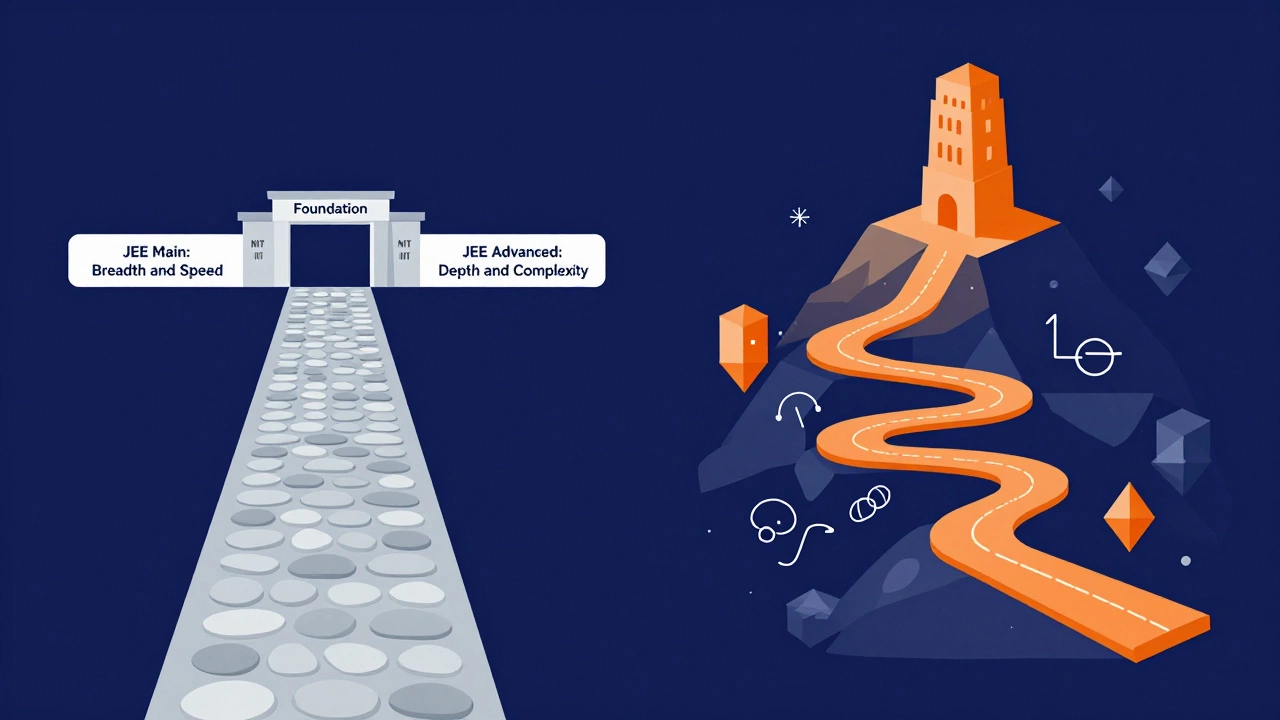
The confusion usually stems from one major fact: there is no single "IIT syllabus." There are two distinct exams-JEE Main and JEE Advanced-and they share a foundation but diverge significantly in depth and style. Getting this wrong means studying too shallowly for Advanced or wasting time on obscure topics for Main. Let’s clear the fog and map out exactly what you need to master to crack these gates.
The Core Foundation: Physics, Chemistry, Mathematics
Before we split into Main and Advanced, understand that both exams rest on three pillars: Physics, Chemistry, and Mathematics. These aren't just subjects; they are the currency of the exam. Every question you answer draws from these domains. The National Testing Agency (NTA) sets the syllabus for JEE Main based on the Class 11 and Class 12 curriculum prescribed by CBSE and state boards, while the Indian Institutes of Technology (IITs) themselves set the syllabus for JEE Advanced, often pushing beyond standard textbooks.
Think of JEE Main as checking if you have built a solid house. It tests breadth and speed. JEE Advanced checks if that house can withstand an earthquake. It tests depth, application, and multi-concept linking. Your study plan must reflect this hierarchy. You cannot skip the basics of Class 11 to rush into Class 12 topics. In IIT JEE, 40% to 50% of the weightage often comes from Class 11 concepts, especially in Physics and Chemistry.
JEE Main Syllabus: Breadth and Speed
JEE Main is your ticket to NITs, IIITs, and other GFTIs (Government Funded Technical Institutions). It also acts as the screening test for JEE Advanced eligibility. The syllabus here is vast but predictable. Questions are generally direct applications of formulas and concepts. You don't need to be a genius to solve them; you need to be accurate and fast.
| Subject | Key Chapters | Why It Matters |
|---|---|---|
| Physics | Mechanics (NLM, Work-Energy), Electrostatics, Modern Physics | These chapters carry the highest weightage and form the basis for complex problems. |
| Chemistry | Organic Chemistry (GOC, Hydrocarbons), Physical Chemistry (Mole Concept, Equilibrium) | Organic is logic-based; Physical is calculation-heavy. Both are scoring. |
| Mathematics | Vectors & 3D Geometry, Calculus (Limits, Integration), Probability | Direct formula application yields quick marks. Vectors are essential for Physics too. |
In Physics, focus heavily on Mechanics. If you struggle with Newton's Laws or Rotational Motion early on, later topics like Gravitation or Current Electricity will feel impossible. Modern Physics (Atoms, Nuclei, Dual Nature) is a goldmine-it requires less derivation and more conceptual clarity, making it high-value for quick marks.
For Chemistry, treat Physical Chemistry like a math subject. Practice numericals daily. Organic Chemistry relies on understanding mechanisms rather than rote memorization. General Organic Chemistry (GOC) is the backbone; if you master inductive effects, resonance, and acidity/basicity, the rest follows naturally. Inorganic Chemistry is purely memory-driven. Stick to NCERT books for this part. Deviating from NCERT for Inorganic in JEE Main is a risky move that rarely pays off.
Mathematics in JEE Main has shifted towards higher-order thinking skills (HOTS) recently. While vectors and matrices remain safe bets, expect more questions from Trigonometry and Algebra that require multiple steps. Don't ignore Statistics and Mathematical Reasoning-they are small chapters but offer guaranteed marks if practiced.
JEE Advanced Syllabus: Depth and Complexity
If you qualify for JEE Advanced, the game changes. The syllabus is not explicitly published as a list of chapters. Instead, it is defined by the level of difficulty and the integration of concepts. The IITs design questions that test your ability to apply basic principles to novel situations. A single question might combine Thermodynamics from Chemistry with Kinetic Theory from Physics.
The core subjects remain the same, but the approach shifts. In Physics, Electrodynamics and Optics become critical. You won't just calculate resistance; you'll analyze circuits with non-ideal batteries and complex networks. Mechanics becomes more abstract, involving variable mass systems and rigid body dynamics in three dimensions.
Chemistry in Advanced is where many students lose their edge. Coordination Chemistry and Chemical Bonding require deep theoretical understanding. You need to predict molecular geometries and magnetic properties without relying on simplified rules. Organic Chemistry moves beyond simple reactions to multi-step synthesis and stereochemistry. You must visualize molecules in 3D space.
Mathematics sees a surge in Calculus complexity. Definite integrals, differential equations, and series convergence are frequent topics. Linear Algebra and Vector Calculus are not just optional extras; they are fundamental tools used across all sections. Expect questions that have multiple correct options or paragraph-based comprehension sets. This format tests consistency under pressure.
Strategic Weightage: Where to Focus First
You cannot study everything equally. Time is your scarcest resource. Analyzing previous years' papers reveals patterns. For JEE Main, approximately 60% of questions come from 15-20 key chapters. Prioritize these "high-yield" areas first. Once you secure these marks, you can expand into lower-weightage topics.
- Physics: Start with Units and Dimensions, then move to Kinematics and Laws of Motion. Build a strong base before touching Electrostatics.
- Chemistry: Begin with Basic Concepts of Chemistry (Mole Concept). Simultaneously, read NCERT Inorganic chapters cover-to-cover. Repetition is key here.
- Math: Master Functions and Graphs first. Understanding how graphs behave helps in solving calculus and algebra problems visually.
A common mistake is skipping "boring" topics like Semiconductors or Biomolecules because they seem less glamorous. However, these topics often appear as straightforward questions in the exam. Ignoring them is leaving free marks on the table. Balance your schedule so that you spend 40% of your time on high-difficulty/high-weightage topics and 60% on moderate-difficulty/high-frequency topics.
Resources That Define Success
The syllabus tells you what to study, but resources tell you how. For JEE Main, NCERT textbooks are non-negotiable. They provide the foundational language of the exam. For JEE Advanced, you need reference books that challenge your limits. H.C. Verma for Physics builds conceptual clarity. O.P. Tandon or R.K. Gupta for Chemistry offer extensive problem sets. For Mathematics, Cengage series or Irodov (for physics-math overlap) are standard choices among serious aspirants.
However, books alone aren't enough. You need to simulate exam conditions. Mock tests are crucial. They expose gaps in your syllabus coverage that you didn't know existed. Analyze every mock test. Did you miss a question because you didn't know the concept, or because you made a silly calculation error? The former requires study; the latter requires practice.
Navigating Changes and Updates
The NTA frequently updates the JEE Main syllabus to align with competency-based assessment. In recent years, they have reduced the emphasis on lengthy derivations and increased the focus on application-based questions. Always check the official NTA website for the latest syllabus document before starting your preparation cycle. What was relevant in 2024 might be tweaked in 2026. Staying updated saves months of wasted effort.
Remember, the syllabus is a map, not the territory. The real journey is building the mental resilience to tackle unfamiliar problems. Focus on understanding principles deeply rather than memorizing solutions. When you truly understand why a formula works, you can derive it in any context, giving you a massive advantage over those who merely recall it.
Is the syllabus for JEE Main and JEE Advanced the same?
No, they are not identical. While both cover Physics, Chemistry, and Mathematics from Class 11 and 12, JEE Main focuses on breadth and direct application of concepts. JEE Advanced goes deeper, testing complex problem-solving, multi-concept integration, and higher-order thinking skills. JEE Advanced does not have a fixed chapter-wise syllabus released publicly; it is based on the overall competence demonstrated in the JEE Main qualifying criteria.
Which chapters are most important for JEE Main?
High-weightage chapters include Mechanics and Electrostatics in Physics; Organic Chemistry (GOC, Hydrocarbons) and Physical Chemistry (Equilibrium, Mole Concept) in Chemistry; and Vectors, 3D Geometry, and Calculus in Mathematics. These topics consistently contribute the most marks in recent exams.
Do I need to study beyond NCERT for JEE Main?
For Chemistry, especially Inorganic and some parts of Organic, NCERT is sufficient and highly recommended. For Physics and Mathematics, NCERT provides the basics, but you will need reference books and problem-solving practice to handle the competitive nature of JEE Main questions effectively.
How much weightage does Class 11 have in IIT JEE?
Class 11 concepts carry significant weightage, typically around 40% to 50%. Subjects like Physics and Chemistry rely heavily on foundational theories introduced in Class 11. Neglecting Class 11 topics can severely impact your performance in Class 12-related advanced problems.
Can I crack JEE Advanced by only studying JEE Main syllabus?
It is extremely difficult. While the core topics overlap, JEE Advanced requires a deeper understanding and the ability to apply concepts in novel ways. Students who only prepare for JEE Main often find JEE Advanced questions too abstract or computationally intensive. Dedicated Advanced-level practice is essential.