



JEE Main vs Advanced Strategy Planner
Configure Your Prep
Select your current status to generate a tailored study roadmap.
Preparation Progress
0%
Select your details and click "Generate Strategy" to see your personalized roadmap.
If you are preparing for engineering in India, the acronym JEE likely pops up everywhere. But here is the catch: JEE isn't just one test. It is a two-stage filter system designed to narrow down millions of aspirants to a few thousand top-tier candidates. Confusing JEE Main with JEE Advanced is the most common mistake students make early in their prep. One gets you into National Institutes of Technology (NITs); the other unlocks the doors to the Indian Institutes of Technology (IITs). Understanding this distinction isn't just about knowing dates; it is about completely changing how you study.
The Core Purpose: Why Two Exams?
To understand the difference, you first need to understand the goal. The Joint Entrance Examination was split into two distinct phases to handle the massive volume of applicants and to test different cognitive skills.
JEE Main is the primary screening test for undergraduate engineering admissions across India. It serves as the gateway for admission to NITs, IIITs, GFTIs, and other state-level engineering colleges. Think of it as a broad net that catches anyone who has mastered the fundamentals of Physics, Chemistry, and Mathematics (PCM).
In contrast, JEE Advanced is an elite examination conducted exclusively for admission to the 23 IITs. This exam does not care if you know the formula; it cares if you can derive the formula under pressure while solving a problem that combines three different concepts at once. It is designed to find students with exceptional analytical depth, not just speed.
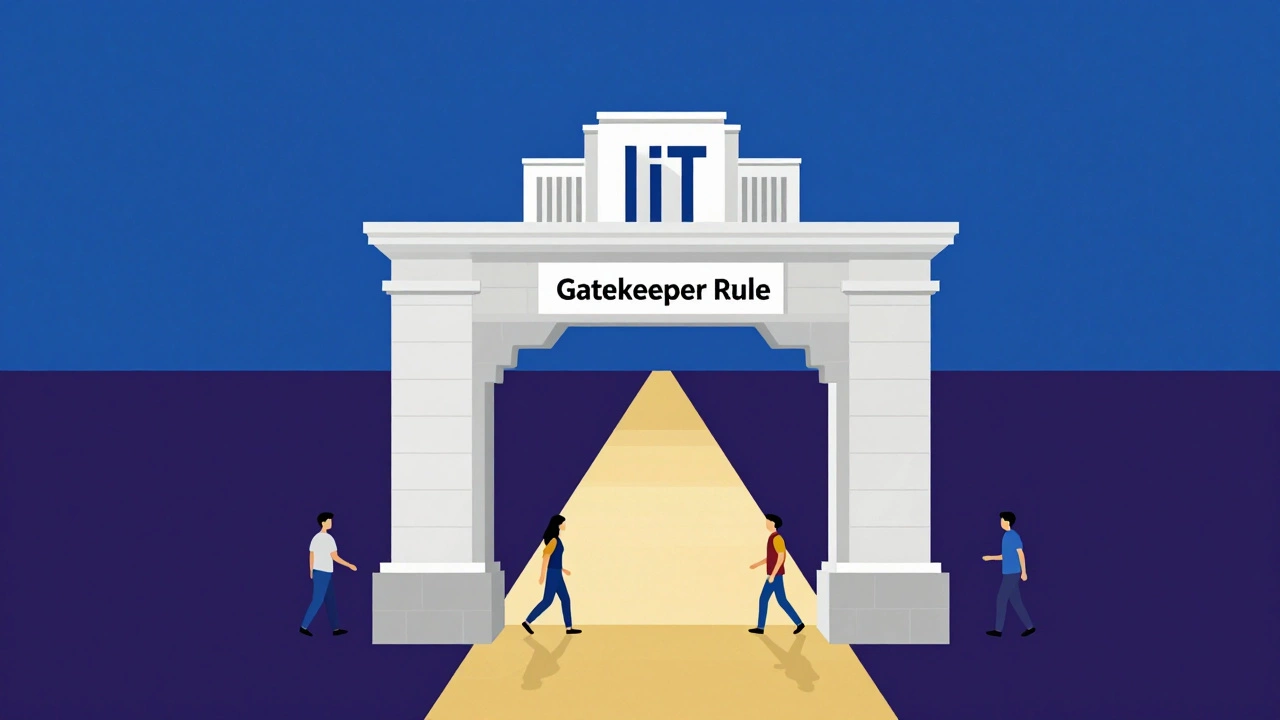
Eligibility: The Gatekeeper Rule
This is where the path splits dramatically. You cannot simply sign up for both exams on the same day.
- JEE Main Eligibility: Open to any student who has passed Class 12 (or appears in 2026) with PCM subjects. There is no cutoff rank from previous years. If you sit for the exam, you get a score.
- JEE Advanced Eligibility: This is strictly merit-based. You must qualify JEE Main first. Specifically, you need to be among the top 2,50,000 scorers in JEE Main. Additionally, your Class 12 aggregate must be at least 75% (or 65% for SC/ST/PwD categories). If you miss the JEE Main cutoff by even one rank, JEE Advanced is off the table entirely.
This creates a high-stakes dependency. JEE Main is not just an end goal for many; it is the mandatory ticket to play the bigger game.
Exam Pattern and Structure
The way these tests are structured tells you exactly what skills they are testing. Let's break down the mechanics.
| Feature | JEE Main | JEE Advanced |
|---|---|---|
| Conducting Body | National Testing Agency (NTA) | Rotating IITs (e.g., IIT Bombay, IIT Madras) |
| Frequency | Multiple sessions per year (usually 4-6) | Once a year only |
| Mode | Computer-Based Test (CBT) | Computer-Based Test (CBT) |
| Duration | 3 hours | 3 hours per paper (2 papers total) |
| Question Types | MCQs and Numerical Value Questions | MCQs, Multiple Correct, Integer Type, Paragraph-based |
| Marking Scheme | +4 for correct, -1 for incorrect MCQs | Varies by question type; some have partial marks |
The key takeaway here is variety. JEE Main is predictable. You know exactly what a question will look like. JEE Advanced throws curveballs. You might face a "multiple correct" question where choosing one right answer and one wrong answer results in zero marks. This forces a higher level of precision and caution.
Syllabus and Depth of Concepts
On paper, the syllabus looks identical. Both exams cover Physics, Chemistry, and Mathematics based on the NCERT curriculum for Classes 11 and 12. However, the application of this syllabus is worlds apart.
In JEE Main, questions are often direct applications of standard formulas. If you memorize the derivation of Newton's Laws or the properties of Quadratic Equations, you can solve most problems. The focus is on accuracy and speed. You need to clear 30-60 questions quickly without making silly errors.
In JEE Advanced, the NCERT book is barely enough. The questions require you to link concepts across chapters. Imagine a Physics problem that requires you to use calculus from Mathematics and thermodynamics from Chemistry simultaneously. The depth is conceptual. You aren't tested on whether you know the formula; you are tested on whether you understand the underlying principle well enough to apply it to a novel situation.
Difficulty Level: A Realistic View
Let’s be honest about the difficulty. JEE Main is competitive, but it is manageable with consistent hard work. Thousands of students score above 99 percentile every year. The challenge lies in maintaining consistency across multiple attempts.
JEE Advanced is significantly harder. It is designed to differentiate the best from the rest. The questions are tricky, time-consuming, and often ambiguous. A single paper can take more than three hours to solve fully because each problem requires deep thought. Many students who score 99.9% in JEE Main struggle to crack the top 10,000 ranks in JEE Advanced because they lack the conceptual flexibility required.
Scoring and Rank Calculation
Your final standing depends on how your score is normalized.
For JEE Main, since there are multiple sessions, the National Testing Agency uses a normalization process. Your raw score is converted into a percentile based on how you performed relative to others in your specific session and shift. This ensures fairness regardless of which date you took the exam. The highest possible percentile is 100, but typically, scores above 99.5 are considered excellent.
For JEE Advanced, there is no normalization across shifts because the exam is usually conducted in a single window (though sometimes two sets exist). Your rank is determined directly by your total score across Paper 1 and Paper 2. Since the number of seats is limited (around 17,000 across all IITs), the competition is fierce. A drop of just 5 marks can mean a difference of several thousand ranks.

Strategic Approach: How to Prepare for Both
You cannot prepare for both exams using the same strategy. Here is how smart aspirants structure their year.
- Phase 1: Foundation (Months 1-6): Focus heavily on NCERT textbooks. Master the basics. Solve previous years' JEE Main questions. Build speed and accuracy. Do not touch advanced-level books yet.
- Phase 2: Transition (Months 7-9): As you approach JEE Main, start introducing slightly tougher problems. Begin practicing JEE Advanced previous years' papers, but don't stress if you fail them. Use this phase to identify weak concepts.
- Phase 3: JEE Main Execution (Months 10-11): Take multiple mock tests. Focus on time management. Aim for a high percentile to secure your JEE Advanced eligibility. Remember, qualifying JEE Advanced is the primary goal here, not necessarily topping it.
- Phase 4: JEE Advanced Deep Dive (Months 12+): Once JEE Main is over, switch gears completely. Stop worrying about speed. Start focusing on depth. Solve complex, multi-concept problems. Study advanced reference books like HC Verma for Physics or RD Sharma for Math. Practice mental resilience-learning to handle difficult, unsolvable-looking questions calmly.
Common Pitfalls to Avoid
Many students fall into traps that cost them dearly. Avoid these mistakes:
- Ignoring JEE Main: Thinking you are too good for JEE Main is dangerous. If you don't qualify, you lose everything. Treat JEE Main as a serious exam, not a warm-up.
- Over-preparing for JEE Main: Spending months on rote memorization instead of conceptual understanding will hurt you in JEE Advanced. Balance is key.
- Burnout: The gap between JEE Main and JEE Advanced is short. Don't exhaust yourself before the main event. Rest and recover after JEE Main before diving into Advanced prep.
- Neglecting Chemistry: In JEE Advanced, Chemistry is often the scoring subject. Students obsessed with Physics and Math often ignore Chemistry, leading to lower overall ranks.
Final Thoughts: Choosing Your Path
Ultimately, JEE Main and JEE Advanced serve different purposes. JEE Main opens doors to respectable engineering colleges across India. JEE Advanced offers entry into the prestigious IIT ecosystem, known for its rigorous academic environment and strong alumni network.
Your goal should not be to choose one over the other, but to excel at both sequentially. Use JEE Main to build confidence and secure eligibility. Use JEE Advanced to push your intellectual limits. Whether you aim for an NIT or an IIT, the journey demands discipline, clarity, and a strategic mindset. Know the rules of the game, respect the difficulty, and prepare accordingly.
Can I appear for JEE Advanced without taking JEE Main?
No, it is impossible. Qualifying JEE Main is a mandatory prerequisite for appearing in JEE Advanced. You must be among the top 2,50,000 rank holders in JEE Main to be eligible.
Which exam is harder: JEE Main or JEE Advanced?
JEE Advanced is significantly harder. While JEE Main tests speed and fundamental accuracy, JEE Advanced tests deep conceptual understanding, analytical ability, and the application of complex, multi-disciplinary concepts.
Do I need to study different syllabi for JEE Main and JEE Advanced?
The official syllabus topics are similar, covering Class 11 and 12 PCM. However, the depth differs. JEE Main relies heavily on NCERT textbooks, while JEE Advanced requires studying beyond NCERT, using advanced reference materials and focusing on complex problem-solving.
What happens if I qualify JEE Advanced but don't get an IIT seat?
If you qualify JEE Advanced but do not secure an IIT seat through counseling, your JEE Main rank remains valid. You can still participate in JoSAA counseling for NITs, IIITs, and other GFTIs using your JEE Main score.
How many times can I attempt JEE Main and JEE Advanced?
As per recent norms, you can attempt JEE Main twice in a calendar year. For JEE Advanced, you can attempt it twice within two consecutive years, provided you meet the age and Class 12 completion criteria.