



Job Readiness Calculator
Based on industry data from 2024, this calculator estimates your job readiness timeline using the most common success paths for self-taught developers.
1 hour
15+ hours
5 hours/week
Your Job Readiness Timeline
Estimated TimeKey actions to take
- Build 3 real projects from scratch
- Practice problem-solving daily
- Join developer communities
Starting
Job-Ready
More than half of today’s professional developers never went to college for computer science. You don’t need a degree to write code that powers apps, websites, or even rocket software. The question isn’t whether it’s possible-it’s how to actually do it without getting lost, burned out, or stuck in tutorial hell.
It’s not about talent, it’s about structure
Saying "anyone can learn to code" sounds nice, but it’s misleading. What really matters is whether you can build structure around your learning. Self-taught coders who succeed don’t just watch YouTube videos or click through freeCodeCamp modules. They follow a clear path: build something small, break it, fix it, repeat.
Take Sarah, a barista in Manchester who started coding at 28. She didn’t know what a variable was. She spent three months building a simple to-do app in JavaScript. Every time it broke, she Googled the error. She joined a Reddit thread for beginners. After six months, she had a portfolio with five projects. Within a year, she got hired as a junior frontend developer. Her secret? No classes. Just consistency.
The myth of the "right" language
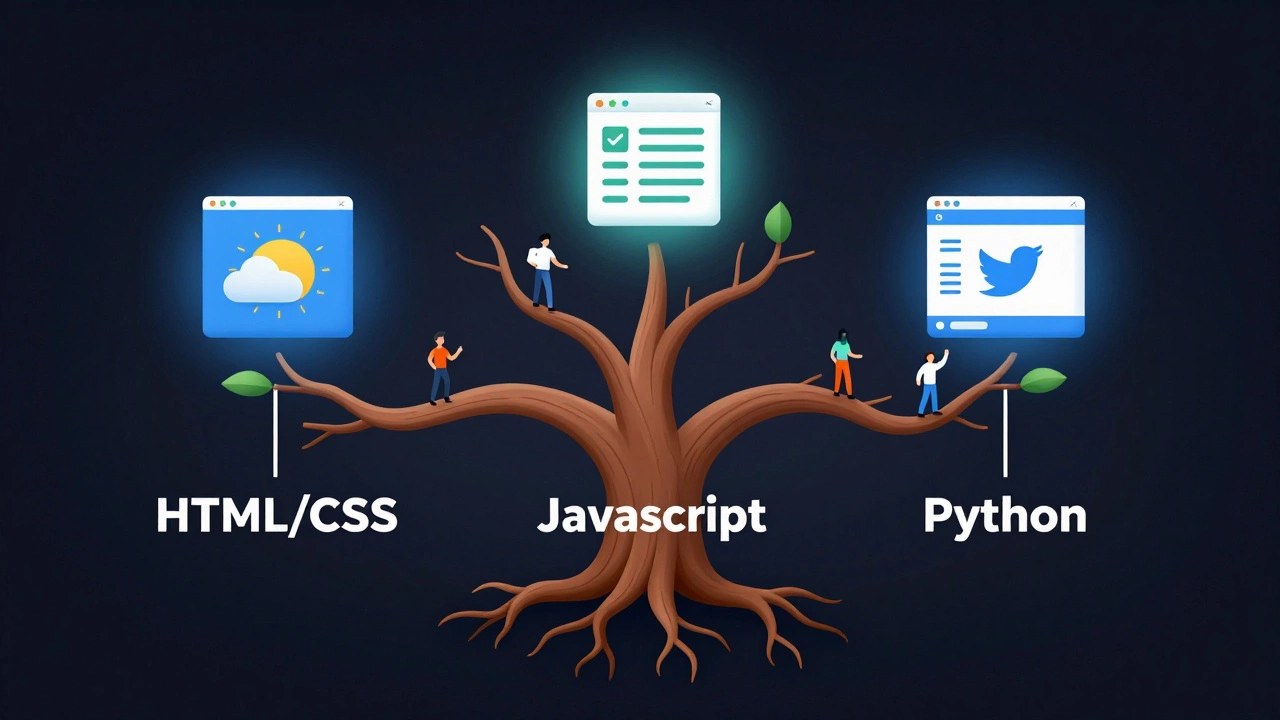
Everyone asks: "Should I learn Python or JavaScript?" The truth? It doesn’t matter-much. What matters is what you want to build. Want to make websites? Start with HTML, CSS, then JavaScript. Want to automate tasks or get into data? Python is your friend. Want to build mobile apps? React Native or Flutter will get you there.
There’s no single "best" language to start with. Companies don’t hire you because you know Java-they hire you because you can solve problems. A self-taught coder who can build a working login system in PHP is more valuable than someone who memorized 10 languages but can’t make anything run.
Start with one. Stick with it for at least six months. Build three real projects. Then branch out. Learning a second language becomes easy once you understand how programming works.
Projects are your resume
Employers don’t care about your GitHub stars. They care if you can ship code. A self-taught coder with three live projects beats someone with a CS degree and a blank portfolio every time.
Here’s what works:
- A personal website with your name, skills, and links to your work
- A tool that solves a real problem-like a budget tracker for freelancers or a recipe organizer
- A clone of a popular site (like a simplified Twitter or Netflix) to practice APIs and state management
Don’t copy-paste tutorials. Build from scratch. Even if it’s ugly. Even if it takes three tries. That’s where real learning happens.
One developer in Leeds built a local event finder for his town using Google Maps API and React. He posted it on Reddit. A small startup saw it, liked it, and hired him as a contractor. He never sent a resume. He sent a link.
Where to learn for free (and what to avoid)
There are dozens of free resources. Most are good. A few are terrible. Here’s what actually works:
- freeCodeCamp-structured, project-based, covers full-stack basics
- The Odin Project-clear roadmap from HTML to deployment, no fluff
- MDN Web Docs-the official reference for web tech. Bookmark it. Use it daily
- YouTube channels like Traversy Media or Web Dev Simplified-short, practical, no sales pitches
Avoid:
- 30-day "become a developer" courses that promise jobs
- Platforms that make you watch 10-hour videos without building anything
- Anything that asks for payment before you’ve tried the free version
The best learning happens when you’re stuck. When you spend an hour trying to fix a broken button. That’s when your brain learns.
Getting hired without a degree
You don’t need a degree. But you do need to prove you can do the work.
Most junior roles now ask for a portfolio, not a diploma. Here’s how to get noticed:
- Put your projects on GitHub. Write clear README files explaining what they do and how you built them
- Join local coding meetups-even virtual ones. Talk to other devs. Ask questions
- Apply to internships or apprenticeships. Many UK companies now offer these for self-taught candidates
- Write short blog posts about what you learned. Even a 300-word post on Medium helps
One applicant in Birmingham applied to 47 jobs over four months. Got 3 interviews. Got one offer. Why? He didn’t say "I’m self-taught." He showed what he built. His cover letter said: "I built a weather app that pulls live data from an API. Here’s the code. Here’s how I fixed the bugs. Here’s how I made it responsive on mobile."
That’s the difference.

The hidden cost: time and mental stamina
Self-teaching takes longer than a bootcamp. You’ll feel lonely. You’ll doubt yourself. You’ll compare yourself to people who went to university. That’s normal.
But here’s what no one tells you: the people who make it through are the ones who treat coding like a habit, not a sprint. Fifteen minutes a day, five days a week, for six months beats 40 hours one weekend and nothing for three weeks.
Set a timer. Code every morning before work. Or during lunch. Or right after dinner. Don’t wait for motivation. Show up anyway.
There’s no magic shortcut. But there is a path: build something, fail, fix it, repeat.
What comes next?
Once you land your first job, the real learning begins. You’ll work with teams, use version control properly, write tests, debug production errors. That’s where most self-taught coders grow fastest.
Don’t stop learning. But don’t feel like you need to catch up. You’re not behind. You’re just on a different route.
Some of the best engineers I’ve worked with never took a single coding class. They learned by doing. By breaking things. By asking for help. By refusing to give up.
You can too.
Can you really get a coding job without a degree?
Yes. In the UK, over 50% of junior developers hired in 2024 didn’t have a computer science degree. Companies care more about what you can build than where you studied. A strong portfolio, clear communication, and problem-solving skills matter more than a diploma.
How long does it take to become job-ready as a self-taught coder?
Most people take 6 to 12 months of consistent effort-about 10 to 15 hours per week. That’s enough time to build three solid projects, learn core concepts like variables, functions, and APIs, and understand how to deploy code. Speed depends on how much you practice, not how smart you are.
What’s the biggest mistake self-taught coders make?
They keep switching tutorials and never finish a project. Watching videos feels productive, but it’s not. Real progress happens when you build something from scratch-even if it’s small. Finish one thing. Then move to the next.
Do you need to know math to be a coder?
Not for most jobs. Basic arithmetic and logic are enough for web development, mobile apps, or content management systems. Advanced math is only needed for areas like game development, machine learning, or graphics programming-less than 10% of coding roles.
Is it too late to start coding at 30, 40, or older?
No. The average age of a new developer in the UK is 32. Many switch careers after working in other fields-teaching, nursing, retail. What matters is persistence, not age. People in their 50s have successfully landed coding jobs by focusing on practical skills and clear communication.