

CBSE Subject Difficulty & Strategy Finder
Select the subject that currently feels like the biggest obstacle in your studies.
Your Action Plan
Subject
Challenge Identified
Description of why it is hard.
Recommended Strategy:
Confidence Boost
0%
"Difficulty is subjective. Consistency beats intensity."
Select a subject and click analyze to reveal your customized study tactics.
Ask any student in India what their biggest fear is, and you’ll likely hear about exams. But if you ask them which specific subject keeps them up at night, the answers get complicated. There is no single "number 1 hardest subject" for everyone. For some, it’s the abstract logic of Mathematics, a core discipline that demands precision and speed. For others, it’s the dense memorization required in Biology, a science focused on living organisms and life processes. The truth is, difficulty is subjective. It depends on your brain type, your study habits, and how well you connect with the teacher.
We often treat school subjects like obstacles to clear rather than skills to build. This mindset makes everything feel harder than it needs to be. If you are struggling right now, you aren’t alone. Millions of students face the same pressure every year under the Central Board of Secondary Education (CBSE), the national education board in India. Understanding why a subject feels hard is the first step to mastering it. Let’s break down the usual suspects for the "hardest" title and see what really makes them tough.
The Case Against Mathematics
Math usually takes the crown for "hardest subject." Why? Because there is no cheating. You can’t bluff your way through a calculus problem. Either you know the formula, or you don’t. In the CBSE curriculum, Math shifts from simple arithmetic in lower grades to complex algebra, trigonometry, and calculus in higher classes. This jump scares many students.
The difficulty here isn’t just intelligence; it’s continuity. Math builds on itself. If you missed a concept in Class 9, Class 10 becomes a nightmare. Students who struggle often have gaps in their foundation. They try to memorize steps without understanding the 'why.' When a question changes slightly, they freeze. To beat this, you need to practice daily, not just before exams. Treat math like a language-speak it every day.
Biology: The Memory Monster
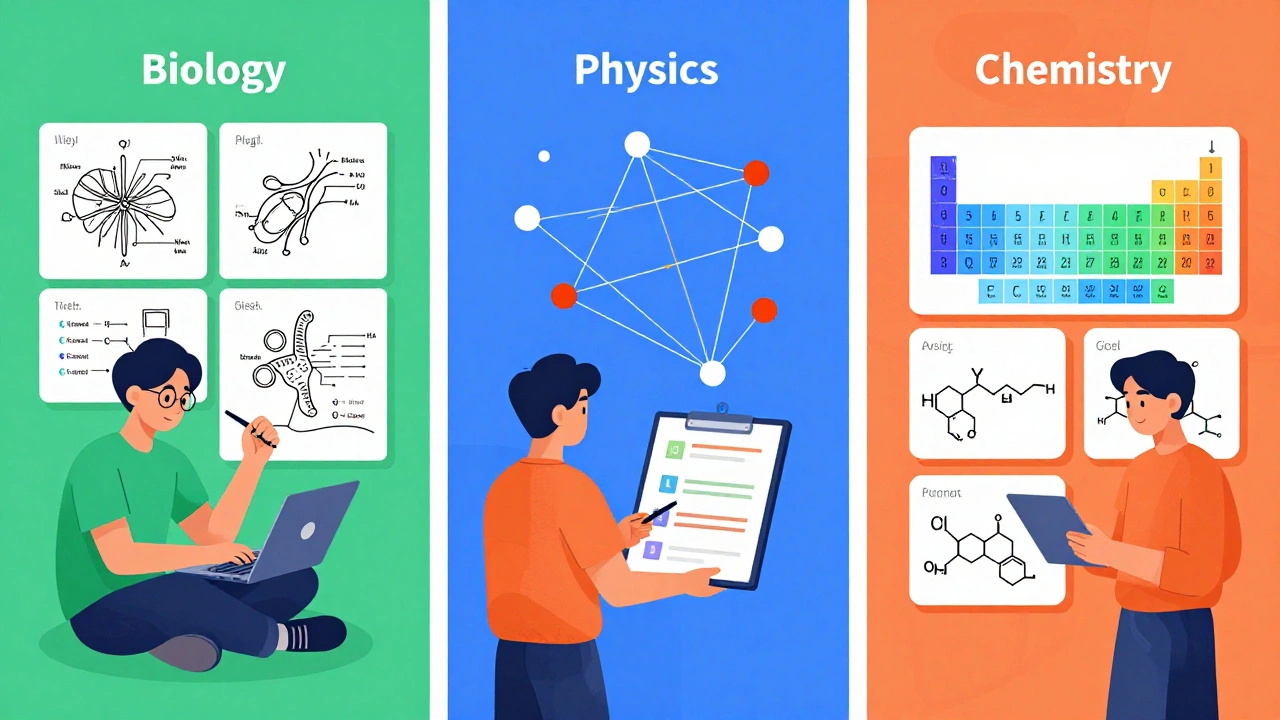
If Math is about logic, Biology is about volume. For students aiming for medical careers, Biology is non-negotiable. But for those who hate rote learning, it feels impossible. The NCERT textbooks for Biology are packed with diagrams, processes, and terminology. You need to remember the Krebs cycle, the human nervous system, and plant anatomy all at once.
The challenge with Biology is retention. You might understand photosynthesis today, but forget the details by next week. The trick isn’t reading the book ten times. It’s active recall. Draw the diagrams from memory. Teach the concepts to a friend. Turn facts into stories. When you make the information personal, it sticks better. Also, don’t ignore the diagrams. In CBSE exams, labeled diagrams carry significant marks and can save you when words fail.
Physics: The Logic Trap
Physics sits between Math and real-world application. It requires mathematical skill but also conceptual clarity. Many students find Physics harder than Math because you can’t just plug numbers into a formula. You need to visualize forces, motion, and energy. If your mental image is wrong, your answer will be wrong.
In CBSE, topics like Electromagnetism and Optics trip up many learners. These areas are abstract. You can’t see magnetic fields. You have to trust the theory. The best approach is to solve numerical problems slowly. Focus on understanding the physical situation first. Ask yourself: What is moving? What forces are acting? Once the picture is clear, the math follows easily. Don’t rush to calculate. Rushing is the enemy of accuracy in Physics.
Chemistry: The Odd One Out
Chemistry is unique because it has three faces: Physical, Organic, and Inorganic. Physical Chemistry is like Math-it uses formulas and calculations. Organic Chemistry is logical, involving reaction mechanisms and electron movement. Inorganic Chemistry is pure memory, filled with exceptions and periodic trends.
This mix confuses students. They use a memorization strategy for Organic Chem and fail. They use a calculation strategy for Inorganic and fail again. Success in Chemistry means switching gears. Treat each branch differently. For Organic, draw structures repeatedly. For Inorganic, create charts and flashcards. For Physical, practice units and conversions. Recognizing these distinct styles reduces the stress significantly.
Languages and Humanities
We often forget that English, Hindi, or History can be just as demanding. Writing a perfect essay requires structure, vocabulary, and critical thinking. History isn’t just dates; it’s cause and effect. Analyzing historical events requires connecting social, economic, and political factors. Students who focus only on STEM subjects sometimes underestimate the effort needed for humanities. Scoring high in languages requires consistent writing practice and reading diverse materials. It’s not easy work, even if it doesn’t involve equations.
Why Does Everything Feel Hard?
Sometimes, the subject isn’t the problem. Your environment is. Distractions play a huge role. If you are studying while checking social media, your brain never enters deep focus mode. You spend two hours studying but only retain twenty minutes of content. This inefficiency makes the workload feel heavier.
Also, compare yourself to others less. Every student learns at a different pace. Some grasp concepts quickly; others need more repetition. Neither is wrong. The key is consistency. Small, regular efforts beat last-minute cramming every time. Create a schedule that includes breaks. Your brain needs rest to process information. Sleep is part of studying, not separate from it.
Speaking of distractions, managing your digital life is crucial. We live in an age where attention is constantly auctioned off. Finding peace is a skill. Sometimes, stepping away from screens entirely helps reset your mind. For example, if you ever travel abroad and need a break from routine, resources like this directory can help you navigate new environments safely and discreetly, allowing you to recharge before returning to your studies with fresh eyes.

Strategies to Conquer Any Subject
Regardless of which subject you find hardest, certain strategies work universally. Here is how top performers handle difficult material:
- Active Recall: Close the book and recite what you learned. Testing yourself is stronger than re-reading.
- Spaced Repetition: Review material at increasing intervals. Day 1, Day 3, Day 7. This moves info to long-term memory.
- Feynman Technique: Explain the concept in simple terms, as if teaching a child. If you get stuck, go back to the source.
- Past Papers: Solve previous years’ CBSE questions. They reveal patterns and important topics.
- Group Study: Discuss doubts with peers. Explaining to others clarifies your own understanding.
Avoid passive studying. Highlighting text gives a false sense of mastery. You recognize the words, but you haven’t processed them. Write summaries. Make mind maps. Engage with the content physically and mentally.
The Role of Teachers and Resources
Your teacher matters. A great teacher simplifies complexity. If you don’t understand your class explanation, seek alternatives. Online videos, educational apps, and peer tutoring can fill the gaps. Don’t stay stuck on one method. Use multiple sources until the concept clicks. The internet offers endless free resources. Use them wisely. Verify information against your textbook to ensure accuracy.
Parents also play a part. Pressure helps only up to a point. After that, it causes anxiety, which blocks learning. Open communication with family about your struggles creates support, not stress. Share your goals and fears. Let them help you plan, not just judge your results.
| Subject | Main Challenge | Best Strategy |
|---|---|---|
| Mathematics | Gaps in foundational knowledge | Daily practice and concept mapping |
| Biology | High volume of memorization | Active recall and diagram drawing |
| Physics | Abstract visualization | Slow numerical solving and conceptual checks |
| Chemistry | Mixed learning styles | Tailored approaches for each branch |
| English/Humanities | Structural and analytical depth | Regular writing and critical reading |
Conclusion: It’s About Persistence
There is no magic pill for hard subjects. The "number 1 hardest subject" is simply the one you avoid. Face it early. Break it down. Celebrate small wins. Over time, the mountain becomes a hill. Remember, school tests your ability to learn, not just what you know. Build resilience. Stay curious. You’ve got this.
Is Math really the hardest subject in CBSE?
For many students, yes, due to its cumulative nature. However, difficulty varies by individual aptitude. Some find Biology or Physics harder because of memorization or abstract concepts.
How can I improve in a subject I find difficult?
Start with basics. Identify weak areas. Use active recall techniques. Practice regularly. Seek help from teachers or online resources. Consistency is key.
Does CBSE change its syllabus frequently?
CBSE updates syllabus periodically based on educational trends. Always check the latest official notification for current year requirements to avoid outdated study material.
Are online courses helpful for CBSE preparation?
Yes, especially for visual learners. Platforms offer video explanations, doubt-solving sessions, and mock tests. Choose reputable providers aligned with NCERT standards.
What is the best time to study difficult subjects?
Most people are fresher in the morning. Study hard topics then. Save lighter tasks like revision or notes for later in the day when energy dips.