Dubai vs India Education: Which System Is Better for Students?
Compare Dubai's modern, international schools with India's massive, diverse system. Learn about curriculum, cost, quality and global pathways to decide which education fits your goals.
When you think about Dubai education, the system of schools, curricula, and learning environments in Dubai that serves a highly international population. Also known as expat-friendly education in the UAE, it blends global standards with local needs, making it one of the most diverse education systems in the world. Unlike India’s centralized boards like CBSE or ICSE, Dubai’s schools follow a patchwork of international systems — IB, British (IGCSE), American, and even Indian curricula — all under one roof. This isn’t just about convenience for expats. It’s about choice, quality, and competition. Parents pick schools based on what works for their child’s future, not just what’s nearby.
One of the biggest draws is the IB curriculum, a globally recognized, inquiry-based education framework used in over 5,000 schools worldwide. Also known as International Baccalaureate, it’s the top pick for families planning to send kids to universities in the US, UK, or Canada. Schools like GEMS Wellington, Dubai American Academy, and Jumeirah College offer IB from kindergarten through grade 12. But you’ll also find plenty of schools sticking to the British curriculum, a structured, exam-focused system based on the UK’s National Curriculum and leading to IGCSE and A-Levels. Also known as Cambridge curriculum, it’s popular among families from the UK, South Asia, and the Gulf. The Indian curriculum is still strong too — many CBSE and ICSE schools operate in Dubai, especially for families planning to return to India for college prep. This mix means students in Dubai can switch between systems without losing academic momentum.
What’s missing? High-stakes national exams like JEE or NEET. Dubai doesn’t have its own version of UPSC or Gaokao. Instead, students take international exams — SAT, ACT, IELTS, IB Diplomas — to get into universities abroad. That’s a big shift from India’s exam-heavy culture. In Dubai, the pressure isn’t about ranking against 10 million others. It’s about standing out in a global applicant pool. This changes how students think about learning. They focus more on critical thinking, projects, and real-world skills — not just memorization.
For parents, the cost is a major factor. Top international schools charge $15,000 to $30,000 a year. That’s more than most Indian private schools, but less than London or New York. Public schools are rare and mostly for Emirati citizens. Most expats have no choice but to go private. And with over 80% of Dubai’s population being foreign-born, the demand never drops. Schools are always adding new programs, hiring international teachers, and upgrading labs and tech.
If you’re coming from India, Dubai education feels both familiar and foreign. You’ll recognize the focus on academics, but you’ll notice the lack of rote learning. You’ll see kids using tablets in class, not just notebooks. You’ll hear teachers talking about resilience and creativity, not just marks. And you’ll find that many Indian students here are preparing not just for IIT or AIIMS, but for Harvard, UCL, or Melbourne. The goal isn’t just to pass an exam — it’s to build a future that crosses borders.
Below, you’ll find real insights from parents, students, and educators who’ve lived through this system. From choosing the right school to handling the transition from CBSE to IB, these posts give you the practical details you won’t find in brochures.
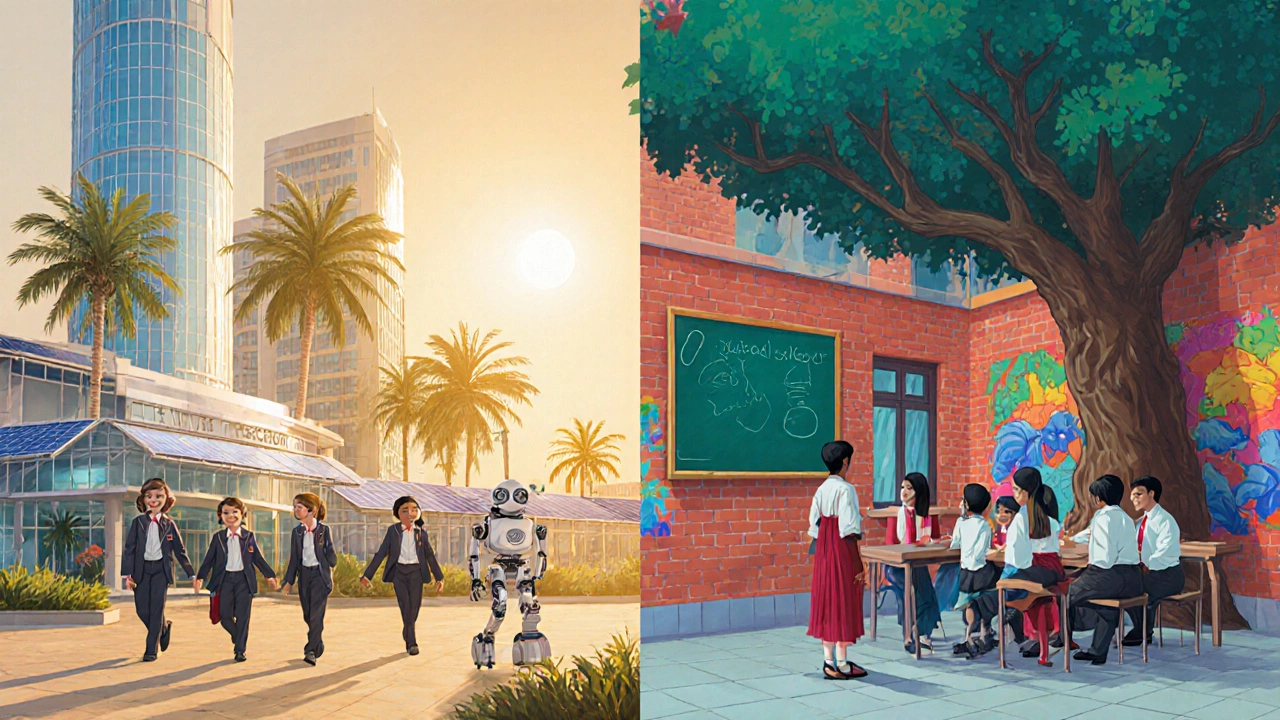
Compare Dubai's modern, international schools with India's massive, diverse system. Learn about curriculum, cost, quality and global pathways to decide which education fits your goals.