



IIT JEE 6-Month Preparation Planner
Your Current Status
Enter your details to see your personalized IIT JEE preparation roadmap.
This tool uses strategic analysis based on high-yield topics and proven preparation methods.Imagine sitting for the IIT JEE is India's most prestigious engineering entrance examination conducted by the National Testing Agency (NTA) for JEE Main and IITs for JEE Advanced with just six months of preparation under your belt. Most students spend two years grinding through textbooks, attending coaching classes, and solving thousands of problems. But what if you only have half that time? The short answer is yes, it is possible. However, "possible" doesn't mean "easy." It means you need a ruthless, strategic approach that prioritizes high-yield topics over comprehensive coverage.
In July 2026, the competition remains fierce. With lakhs of aspirants aiming for seats at the Indian Institutes of Technology, standing out requires more than just hard work; it requires smart work. This guide breaks down exactly how top scorers manage to clear the cutoff and even secure ranks within a condensed timeline. We will look at realistic expectations, subject-wise strategies, and the psychological resilience needed to pull this off.
The Reality Check: What Does "Cracking" Mean?
Before diving into the schedule, let’s define success. For many, cracking IIT means getting a rank under 1,000 in JEE Advanced is the second stage of the Joint Entrance Examination required for admission to undergraduate programs at the Indian Institutes of Technology. In six months, achieving a single-digit or low three-digit rank from scratch is statistically improbable unless you are already a prodigy. However, securing a rank between 5,000 and 20,000-which opens doors to good branches in older IITs or premier NITs-is a realistic target for a dedicated student with a strong foundation in Class 11 and 12 concepts.
If you are starting from zero, meaning you haven’t touched Physics, Chemistry, or Math since school, your goal should shift slightly. Focus on clearing JEE Main is the primary eligibility test for JEE Advanced and also serves as an entrance exam for NITs and other central government-funded technical institutions with a score above 95 percentile. This still qualifies you for excellent engineering colleges across India. The key is to stop comparing yourself to students who have been preparing for two years and start optimizing for your own potential.
Phase 1: Diagnostic Assessment and Resource Selection (Weeks 1-2)
You cannot fix what you don’t measure. The first two weeks are not about learning new content; they are about understanding your current baseline. Take a full-length mock test using previous year papers from 2023, 2024, or 2025. Analyze every question. Did you get it wrong because of a conceptual gap, a calculation error, or lack of time? This analysis dictates your entire roadmap.
Next, trim your resources. A common mistake is hoarding books. You don’t need ten different guides for Physics. Stick to the NCERT textbooks for Chemistry and basic theory, and one standard reference book per subject for practice. For Mathematics, focus on problem-solving books like those by R.D. Sharma or Cengage, but only cover the chapters relevant to your weak areas. Quality beats quantity when time is scarce.
- Physics: H.C. Verma for concepts, I.E. Irodov for advanced problems (optional).
- Chemistry: NCERT is non-negotiable for Organic and Inorganic. Physical Chemistry requires numerical practice from O.P. Tandon or similar.
- Mathematics: Focus on calculus and algebra. Use modules from reputable coaching institutes if self-study feels overwhelming.
Phase 2: High-Yield Topic Mastery (Months 1-3)
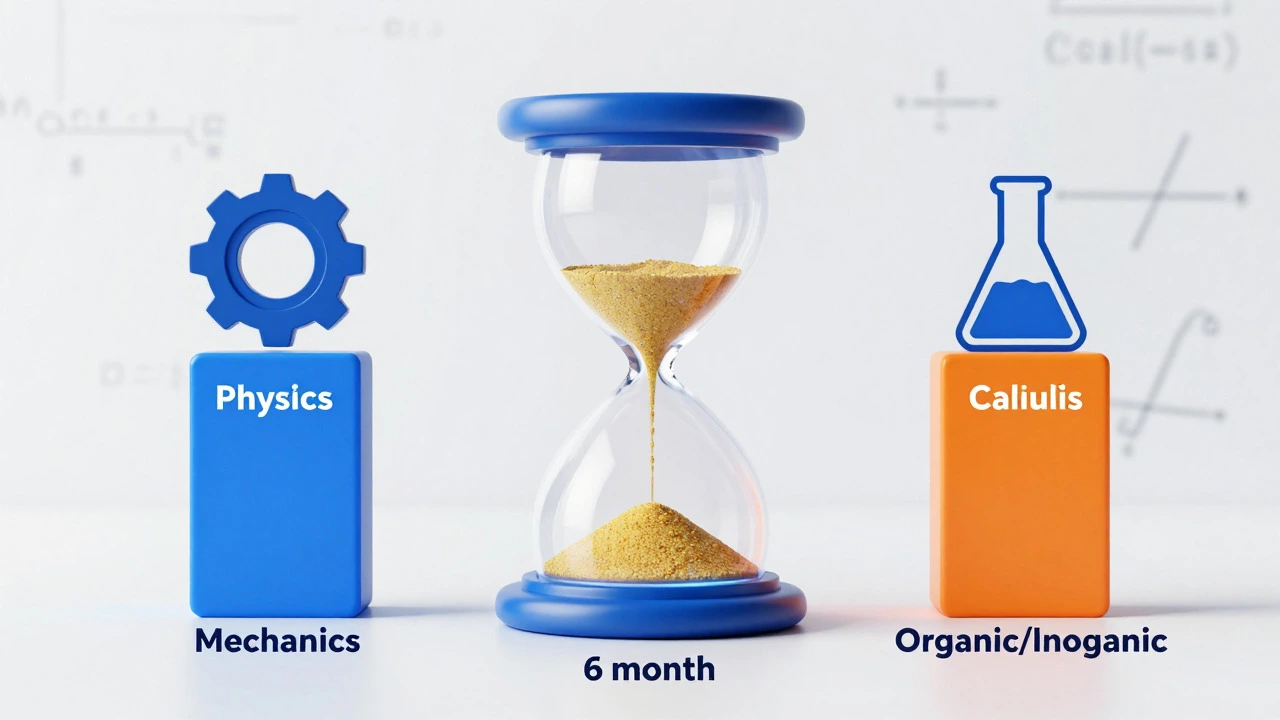
In a six-month window, you cannot master every topic. You must prioritize. Approximately 70% of the JEE syllabus carries 80% of the weightage. Identify these high-weightage chapters and crush them first.
For Physics, mechanics and electromagnetism are giants. If you understand Newton’s Laws, rotational motion, and electrostatics deeply, you can tackle a significant portion of the paper. Don’t just read the formulas; derive them. Understanding the derivation helps in remembering the application during the exam. For Chemistry, Organic Chemistry is logical once you grasp reaction mechanisms. Inorganic Chemistry is purely memorization-heavy, so use spaced repetition techniques to retain periodic table trends and coordination compounds.
Mathematics is often the differentiator. Calculus (limits, continuity, differentiation, integration) and Algebra (complex numbers, matrices, determinants) are recurring themes. Spend at least 40% of your study time here. Solve problems until the patterns become intuitive. If you see a quadratic equation, you should instantly think about its roots and discriminant without hesitation.
| Subject | Priority Chapters | Weightage Estimate |
|---|---|---|
| Physics | Mechanics, Electrostatics, Magnetism, Modern Physics | ~45% |
| Chemistry | Organic Mechanisms, Coordination Compounds, Thermodynamics | ~40% |
| Mathematics | Calculus, Vectors & 3D Geometry, Probability | ~50% |
Phase 3: Intensive Practice and Mock Tests (Months 4-5)
By month four, you should have covered the core syllabus. Now, the focus shifts entirely to application. Start taking one full-length mock test every weekend. Treat it like the real exam: sit for three hours, no distractions, no phone. After the test, spend twice as much time analyzing it as you did taking it.
This phase is where most students burn out. To prevent this, maintain a consistent sleep schedule. Your brain consolidates memory during sleep. If you cut sleep to study more, you lose retention. Aim for 7-8 hours. Additionally, incorporate physical activity. Even a 20-minute walk can reset your focus levels.
Identify your "easy marks." These are questions you can solve quickly and accurately. In the exam, secure these first. Leave the complex, time-consuming problems for last. Many students lose marks not because they couldn’t solve a problem, but because they spent too long on it and ran out of time for easier ones.

Phase 4: Revision and Exam Strategy (Month 6)
The final month is for polishing. Stop learning new topics. Instead, revise formulas, reaction mechanisms, and important theorems. Create short notes or flashcards for quick revision. Re-solve the mistakes you made in previous mock tests. If you got a question wrong due to a silly error, ensure you don’t repeat it.
Develop a personalized exam strategy. Some students prefer starting with Chemistry because it’s faster to score. Others begin with their strongest subject to build confidence. Experiment with different orders in your mock tests to find what works best for you. Remember, the negative marking scheme in JEE means accuracy is more important than attempting every question. If you aren’t sure, skip it.
Mental Resilience and Avoiding Burnout
Preparing for IIT JEE in six months is mentally exhausting. You will face doubt, fear, and fatigue. Acknowledge these feelings. Talk to friends, family, or mentors. Don’t isolate yourself. Join online communities where students share experiences and tips. Seeing others struggle and succeed can be incredibly motivating.
Avoid comparison traps. Social media often highlights only the successes, hiding the struggles. Focus on your progress. Celebrate small wins, like mastering a difficult chapter or improving your mock test score by 10 points. Consistency is key. Studying 8 hours every day is better than studying 14 hours for three days and then burning out for a week.
Can I crack IIT JEE Advanced in 6 months if I am starting from scratch?
Starting from absolute zero makes cracking JEE Advanced extremely difficult in six months. While clearing JEE Main with a good percentile is achievable, JEE Advanced requires deep conceptual clarity and problem-solving speed that typically takes longer to develop. If you have a strong Class 11 and 12 foundation, it is possible. Otherwise, aim for top NITs or IIITs via JEE Main first.
How many hours should I study daily to crack IIT in 6 months?
Quality matters more than quantity. Aim for 8-10 hours of focused study per day. This includes active problem-solving, revision, and mock tests. Ensure you take regular breaks to avoid mental fatigue. Consistent 8-hour days are far more effective than erratic 14-hour days.
Is NCERT enough for Chemistry in IIT JEE?
For Inorganic and Organic Chemistry, NCERT is essential and largely sufficient for JEE Main. For JEE Advanced, you need additional reference books for deeper understanding and complex problems. For Physical Chemistry, NCERT provides the basics, but you must practice numerical problems from standard reference books to handle the difficulty level of Advanced.
Should I join a coaching institute or self-study for 6-month preparation?
If you have strong self-discipline and access to quality study materials, self-study can work. However, a crash course or online program can provide structure, regular testing, and expert guidance, which is valuable in a short timeframe. Choose based on your learning style and budget. Many successful students have used hybrid models, combining online lectures with self-practice.
What is the most important tip for cracking IIT JEE in a short time?
Focus on high-weightage topics and master them completely. Don’t try to cover the entire syllabus superficially. Prioritize accuracy over attempt rate. Regular mock tests and thorough analysis are crucial to identify weaknesses and improve speed. Stay consistent and manage your stress levels effectively.