
When people ask if Netflix is a digital platform, they’re usually thinking about education. After all, we hear about digital platforms like Coursera, Udemy, or Khan Academy every day. But Netflix? It’s not a school. It’s not a course. So why does this question even come up?
What Makes Something a Digital Platform?
A digital platform isn’t just a website or an app. It’s a system that connects users to content, tools, or services - often with some level of interaction, personalization, or structure. Think of it like a highway: it doesn’t produce the cars, but it lets them move, connect, and reach destinations. Platforms like Google Classroom or edX give you lessons, quizzes, progress tracking, and certificates. They’re built for learning.
Netflix doesn’t do any of that. No assignments. No exams. No instructor feedback. No learning paths. You press play, you watch, you pause. That’s it. So technically, it’s not an education platform. But is it still a digital platform? Yes - just not for learning.
Netflix as a Digital Platform: The Real Definition
Netflix is a digital platform in the purest sense: it delivers entertainment content over the internet at scale. It hosts millions of hours of video, personalizes recommendations using AI, adapts to your device, and updates its library daily. It connects users with content creators, studios, and producers. It collects data on what you watch, when, and how long. All of that fits the definition of a digital platform.
It’s not unique - YouTube, Spotify, Amazon Prime Video, and Disney+ are the same. They’re all digital platforms built for mass consumption. But here’s the key difference: education platforms are designed to change how you think. Netflix is designed to change how you spend your time.
Why People Confuse Netflix with Learning Platforms
You might be wondering why this confusion even exists. The answer is simple: content is content. If you’re watching a documentary on the rise of ancient Rome, a deep dive into climate science, or a series about AI ethics, it feels educational. And it is - in a loose sense. But feeling educated isn’t the same as being taught.
There’s a big gap between learning passively and learning systematically. Watching Our Planet on Netflix might make you care more about conservation. But if you want to understand carbon cycles, policy frameworks, or biodiversity metrics? You need structured lessons, assessments, and feedback - which Netflix doesn’t offer.
Many learners use Netflix as a supplement. A student studying history might watch The Crown to get context. A language learner might binge Stranger Things with subtitles. But that’s not what Netflix was built for. It’s a tool people repurpose - like using a hammer to screw in a nail. It works, but it’s not the right tool.
How Netflix Compares to Real E-Learning Platforms
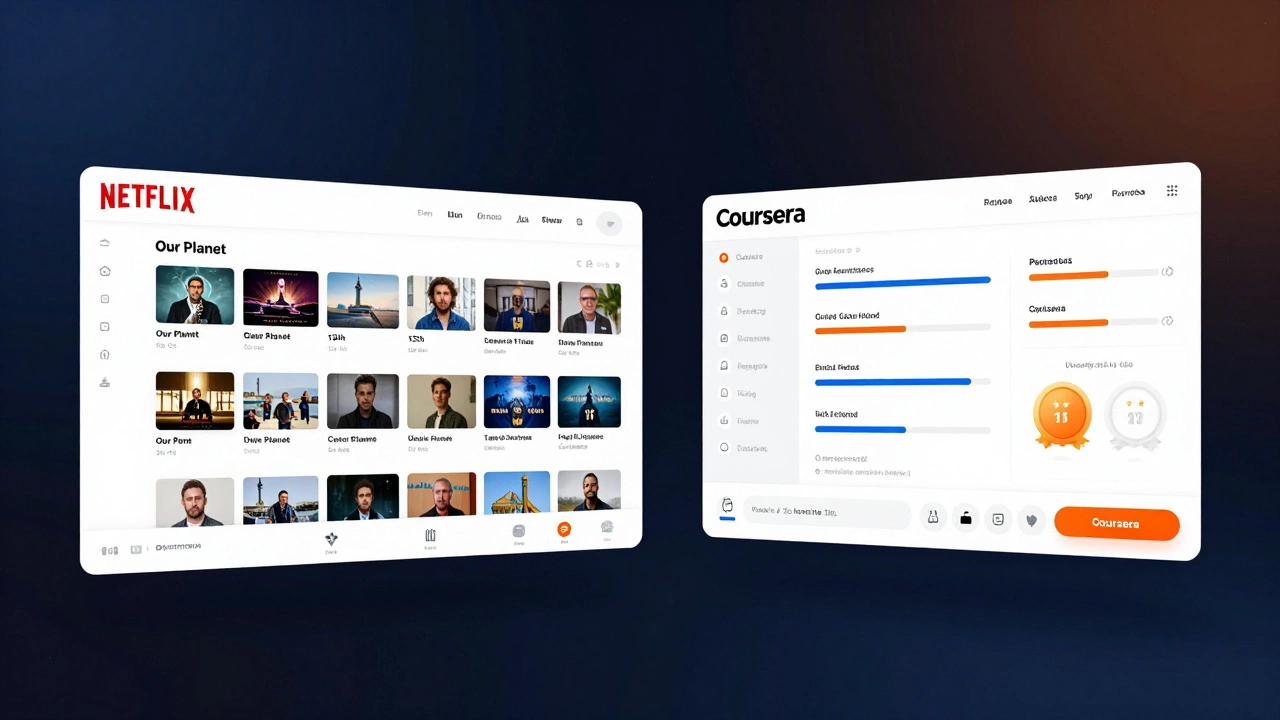
Let’s look at how Netflix stacks up against platforms designed for learning:
| Feature | Netflix | Udemy or Coursera |
|---|---|---|
| Content Type | Entertainment (documentaries, series, films) | Structured courses with modules |
| Learning Path | None | Yes - sequential lessons |
| Assessments | No quizzes or tests | Quizzes, assignments, final exams |
| Progress Tracking | Watch history only | Completion badges, certificates |
| Instructor Interaction | No | Yes - forums, Q&A, feedback |
| Learning Goals | Entertainment, relaxation | Skill mastery, career advancement |
The differences aren’t minor. They’re fundamental. One is a library of stories. The other is a classroom.
Can Netflix Help You Learn? Sure - But Not Like a Platform
Let’s be clear: Netflix can help you learn. Documentaries like The Social Dilemma or 13th spark real understanding. Series like Chemistry: A Volatile History explain complex topics in engaging ways. But you’re not enrolled. You’re not graded. You’re not accountable.
Compare that to a platform like Khan Academy. If you watch a video on quadratic equations, you can immediately practice problems, get instant feedback, and move forward only when you’ve mastered it. Netflix gives you context. Learning platforms give you competence.
There’s no shame in using Netflix to explore ideas. But if you’re trying to build skills - for a job, an exam, or a degree - you need more than passive watching. You need structure. You need feedback. You need a system.
So, Is Netflix a Digital Platform?
Yes - absolutely. But not an e-learning one.
It’s a digital entertainment platform. It’s one of the largest in the world, serving over 260 million subscribers in 2026. It uses AI to recommend shows, scales globally across devices, and continuously improves its delivery. It’s a technological marvel.
But calling it an e-learning platform is like calling a movie theater a school because you watched a film about biology. The content might be educational. The experience isn’t.
If you’re looking for real learning - the kind that changes your skills, your resume, or your career - stick to platforms built for that. Netflix is great for background watching. But if you want to grow, you need more than a play button.
What Should You Use Instead?
If you’re serious about learning, here are a few platforms that actually function like e-learning systems:
- Coursera - University-backed courses with certificates
- Udemy - Thousands of on-demand courses on tech, business, and more
- Khan Academy - Free, structured lessons from math to economics
- edX - Courses from MIT, Harvard, and other top schools
- LinkedIn Learning - Skill-building paths for professional growth
These platforms track your progress, test your knowledge, and give you proof you’ve learned something. Netflix? It just gives you something to watch.