

English Learning Path Recommender
Based on the article, active listening is the foundation of fluency. Enter your current status to get a personalized recommendation.
You’ve probably heard a thousand different tips on how to master English. Some say you need to watch movies without subtitles. Others swear by memorizing vocabulary lists or reading novels. But if you had to pick just one skill-the single most effective lever to pull to get fluent-what would it be?
Most people guess speaking. It makes sense. We learn languages to talk, right? But here’s the uncomfortable truth: trying to speak before you can truly listen is like trying to write a novel before you’ve read a single book. You might form sentences, but they won’t sound natural, and you’ll miss half of what people are saying to you.
The best skill to learn English isn’t speaking. It’s active listening. Specifically, the ability to process spoken language in real-time, decode intonation, and understand context. Without this foundation, every other technique falls flat. Let’s break down why listening is the secret weapon for fluency and how you can train it effectively.
Why Listening Beats Speaking as a Starting Point
Think about how babies learn their first language. They don’t start talking immediately. For the first year or two, they spend almost all their time listening. They absorb the rhythm, the pitch, the sounds, and the patterns of speech. Only after building this massive internal database of "how things sound" do they begin to produce words.
Adult learners often skip this phase because they want quick results. They jump into conversation classes or language exchange apps too early. The result? Frustration. You try to speak, but your brain is stuck translating from your native language word-by-word. Meanwhile, the person talking to you is moving at full speed. You miss key details, misunderstand jokes, and feel lost.
Listening builds your "ear." When you train your ear, you stop hearing English as a stream of individual words and start hearing it as chunks of meaning. This is called lexical chunking, which is the cognitive process of grouping words together into meaningful units rather than processing them individually. For example, instead of hearing "I," "would," "like," "to," "go," your brain processes "I’d like to go" as a single unit. This dramatically speeds up comprehension and makes your own speech more natural because you’re retrieving pre-built phrases, not constructing grammar from scratch.
The Myth of Passive Consumption
Many learners make a critical mistake: they confuse passive consumption with active listening. Putting on an English podcast while you wash dishes or drive doesn’t count. If your brain isn’t fully engaged, you’re not learning; you’re just background noise. Studies in second-language acquisition show that passive exposure has minimal impact on fluency unless you already have a high level of proficiency.
To make listening work, you need to be intentional. Here’s how to shift from passive to active:
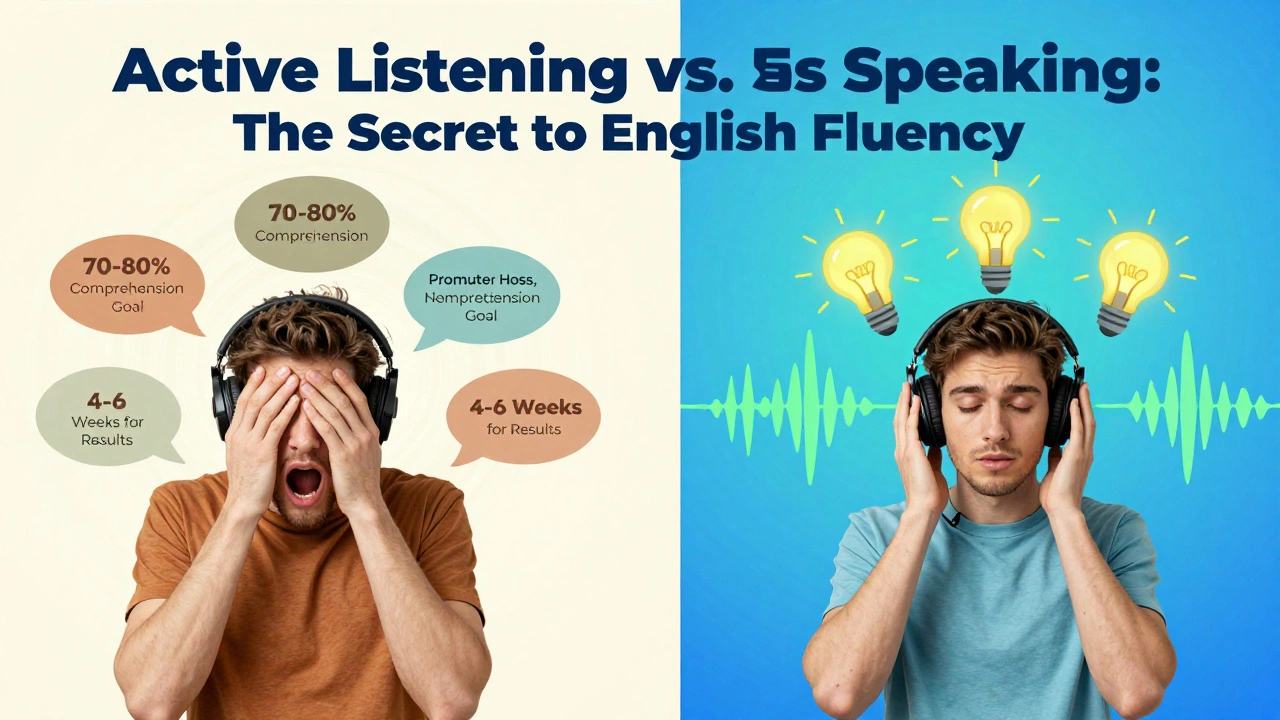
- Select content slightly above your level: If you understand 100% of what you hear, you’re not learning. If you understand less than 60%, you’re overwhelmed. Aim for 70-80% comprehension. This is known as the "i+1" principle in linguistics, where input should be just one step beyond your current ability.
- Focus on specific elements: Don’t just listen for general meaning. In one session, focus only on linking sounds (how words blend together). In another, focus on identifying question tags. In a third, track how the speaker uses intonation to show sarcasm or emphasis.
- Use transcripts strategically: Listen first without text. Then listen again with the transcript. Highlight words you missed. Finally, listen a third time without the text to see if those gaps are filled.
How Active Listening Improves Your Speaking
You might still be wondering, "But I want to speak!" Here’s the connection: your pronunciation and accent are directly tied to your listening skills. You cannot pronounce a sound correctly if you cannot hear the difference between it and a similar sound in your native language.
For instance, many Spanish speakers struggle with the difference between the English "ship" and "sheep." To their ears, these sounds are identical because Spanish doesn’t distinguish between short and long vowels in this way. Until they train their ears to hear the subtle length difference, their mouths will never produce it accurately. This is why pronunciation guides alone fail. You need auditory discrimination training.
Furthermore, listening helps you master prosody, which is the rhythm, stress, and intonation of speech that conveys emotional tone and grammatical structure. Two people can say the exact same sentence with the same words, but if one uses flat intonation and the other uses rising and falling tones, the second speaker will sound confident and engaging. The first will sound robotic. You learn prosody only by listening to native speakers and mimicking their musicality.
| Approach | Primary Focus | Time to Fluency | Common Pitfall |
|---|---|---|---|
| Vocabulary Memorization | Word definitions | Slow | Knowing words but unable to use them in context |
| Grammar Drills | Sentence structure rules | Moderate | Overthinking rules during conversation, leading to hesitation |
| Active Listening | Sound patterns & context | Fastest | Requiring discipline to stay focused |
| Speaking Practice | Output production | Variable | Fossilizing errors if feedback isn't immediate |
Practical Steps to Train Your Ear Daily
You don’t need expensive courses to develop this skill. You need consistency and the right materials. Here is a simple daily routine that takes 30 minutes:
- Minute 0-5: Warm-up with Shadowing. Play a short audio clip (30 seconds) of a native speaker. Listen once. Then, play it again and repeat exactly what they say, matching their speed and emotion. This connects your ear to your mouth.
- Minute 5-20: Deep Listening. Choose a podcast episode or YouTube video relevant to your interests. Listen without pausing. Take notes on key points. Do not look up words yet. Force your brain to infer meaning from context.
- Minute 20-30: Analysis. Now, look at the transcript or subtitles. Identify three phrases or idioms you didn’t catch. Write them down. Listen to those specific segments again until you can hear exactly how the words link together.
Consistency matters more than intensity. Ten minutes of active listening every day is far better than two hours of passive watching once a week. Over time, you’ll notice that English starts to "click." You’ll find yourself understanding faster, needing fewer pauses, and feeling less anxious when entering conversations.
When to Start Speaking
This doesn’t mean you should never speak. After about 2-3 months of dedicated active listening, you should integrate speaking exercises. By then, your internal model of English will be strong enough to support output. Start with low-stakes environments: record yourself summarizing what you listened to, talk to yourself in the mirror, or use AI voice tools that provide instant feedback on pronunciation.
The goal is to move from conscious competence (thinking hard about every word) to unconscious competence (speaking naturally). Active listening accelerates this transition by filling your brain with correct examples before you start producing them.
Tools and Resources for Active Listening
You don’t need to rely on generic news broadcasts. Tailor your listening material to your level and interests:
- Beginners: Use podcasts designed for learners, such as "6 Minute English" by BBC or "ESL Pod." These feature clear enunciation and slower pacing.
- Intermediate: Switch to native-content podcasts on topics you enjoy, like true crime, technology, or comedy. Try "This American Life" or "The Daily." The challenge here is dealing with slang, fast speech, and overlapping dialogue.
- Advanced: Engage with complex media like documentaries, TED Talks, or political debates. Focus on nuanced arguments and rhetorical devices.
Technology also plays a role. Apps like Language Reactor, which is a browser extension that enhances Netflix and YouTube viewing with dual subtitles and interactive vocabulary tools can help you visualize what you’re hearing. However, use them as aids, not crutches. The ultimate goal is to understand without any visual support.
Conclusion: Trust the Process
Learning English feels slow when you’re waiting for the breakthrough moment. But fluency isn’t a light switch; it’s a dimmer switch. By prioritizing active listening, you’re turning that switch up gradually, steadily, and surely. You’ll build a foundation that allows your speaking to flourish naturally, without the strain of forcing unnatural patterns. So, put down the vocabulary flashcards for a moment. Put on some headphones. And really listen.
Is reading important if I focus on listening?
Yes, reading supports listening by expanding your vocabulary and reinforcing spelling-sound connections. However, reading alone does not train your ear for the speed and connected speech of real conversation. Use reading as a supplement, not a replacement for auditory input.
How long does it take to see results from active listening?
Most learners report noticeable improvements in comprehension within 4-6 weeks of daily practice. Significant gains in speaking confidence and pronunciation typically follow after 3-6 months, as your brain begins to automate the processing of English sounds.
Should I use subtitles when practicing listening?
Subtitles can be helpful initially, but they often hinder progress if overused. Try to listen without them first. If you must use them, use English subtitles, not translations. Eventually, aim to remove them entirely to force your brain to rely on auditory cues.
What if I don’t understand anything at first?
Start with simpler content. If a native podcast is too fast, switch to learner-specific resources. The key is to find material where you understand at least 60-70%. Gradually increase difficulty as your comprehension improves. Patience is essential.
Can I improve my accent just by listening?
Listening is the prerequisite for improving your accent. You must hear the correct sounds before you can reproduce them. Combine listening with shadowing exercises (mimicking the speaker) to physically train your mouth muscles to form new sounds.