

Free Online Degree Verification Tool
Verify Your Free Degree Program
Check if an institution offers legitimate free, accredited online degrees
Enter an institution name and click "Verify Program" to check if it's a legitimate free online degree program.
You’ve probably seen the ads: "Get a degree for free!" No tuition. No loans. Just click and graduate. It sounds too good to be true-and most of the time, it is. But here’s the real answer: yes, there are free online degrees, but not the kind you think. You won’t find a fully accredited, four-year bachelor’s from Harvard or Oxford without paying a cent. But you can earn a legitimate, recognized degree online without spending a penny-if you know where to look and what to expect.
What counts as a "free online degree"?
Let’s clear up the confusion right away. A free online degree doesn’t mean you get a diploma mailed to your door after watching a few YouTube videos. It means you complete all the coursework, assignments, exams, and requirements of a degree program without paying tuition fees. You still do the work. You still meet deadlines. You still prove you’ve learned the material.
The key difference? You’re not paying the institution for the privilege of learning. Instead, the cost is covered by governments, nonprofits, or universities using public funding or philanthropy. These programs are real. They’re accredited. And they’re growing fast.
Where to find actual free online degrees (2025 edition)
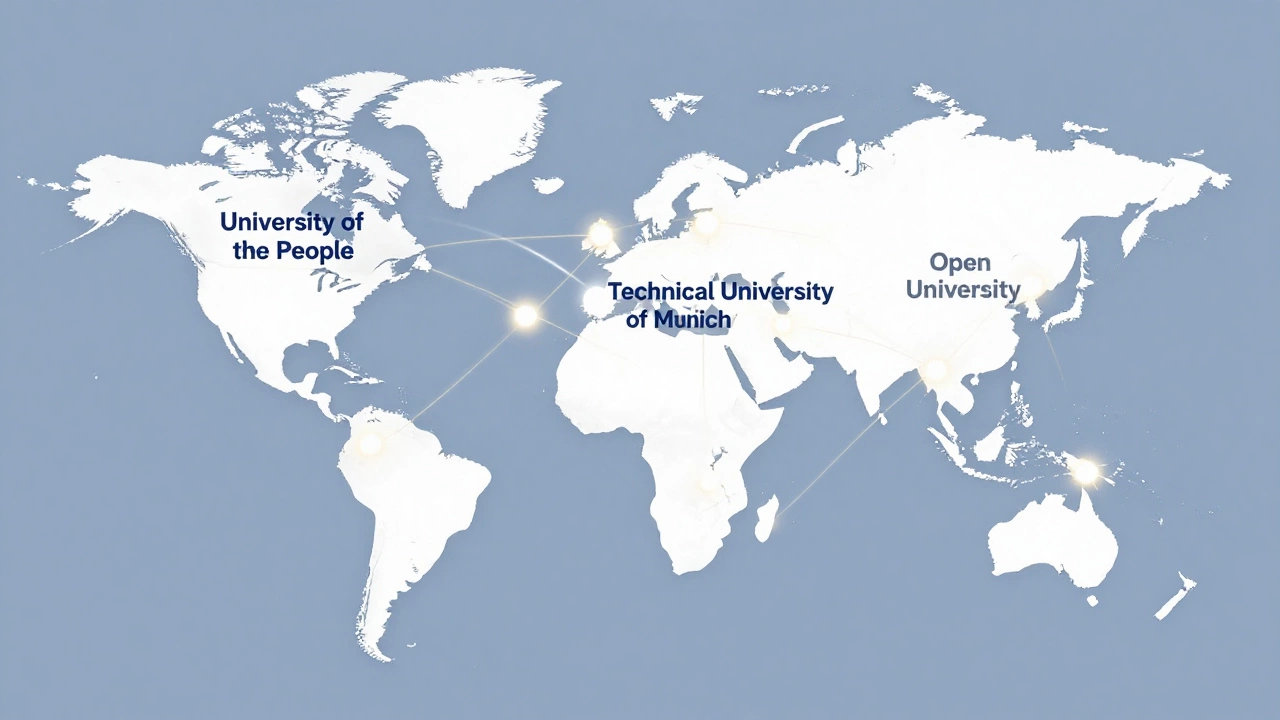
There are only a handful of institutions worldwide offering fully free, accredited online degrees. Most are public universities in Europe, especially in countries where higher education is subsidized. Here are the top three places to look in 2025:
- University of the People (UoPeople) - Based in California but fully online, UoPeople is the only accredited, nonprofit, tuition-free university in the world offering bachelor’s and master’s degrees. You pay no tuition, but you do pay small assessment fees ($120 per course) to cover administrative costs. These fees are waived for those who qualify for financial aid. Degrees are accredited by the Distance Education Accrediting Commission (DEAC), recognized by the U.S. Department of Education. Programs include Business Administration, Computer Science, and Health Science.
- Germany’s public universities - If you’re willing to relocate or live remotely while enrolled, Germany offers free tuition at public universities like the University of Hamburg, Technical University of Munich, and Berlin School of Economics and Law. All courses are in English for international students in many bachelor’s and master’s programs. You only pay a small semester fee (around €150-€350) for student services and public transport. No visa required if you’re studying fully online from outside the EU.
- Open University (UK) - The UK’s Open University offers free access to course materials through its OpenLearn platform. While you can’t earn a full degree for free here, you can complete entire modules, earn credits, and then apply those credits toward a paid degree later. Many students use OpenLearn to test-drive a subject before committing to a full degree program.
What you won’t find: Free degrees from U.S. Ivy League schools
Harvard, Stanford, MIT-they offer hundreds of free online courses through platforms like edX and Coursera. But none of them give you a degree for free. You can audit a class, watch lectures, take quizzes, and even earn a certificate. But that certificate says "Verified" or "Audit," not "Bachelor of Science." It’s valuable for learning, but not for job applications that require a degree.
Some schools, like Arizona State University and the University of the People, partner with platforms to offer low-cost degrees, but they still charge. The only U.S.-based school offering a fully accredited, tuition-free degree is UoPeople. Everything else is either a certificate, a micro-credential, or a paid program.
Accreditation matters-don’t get scammed
There are hundreds of websites promising "free degrees" that are completely fake. They sell diplomas. They don’t teach. They don’t assess. They just print your name on parchment and call it a degree. These are called diploma mills, and they’re illegal in most countries.
How to tell the difference? Check for accreditation. In the U.S., look for DEAC, CHEA, or regional accreditors like SACSCOC. In Europe, check if the university is listed in the European Higher Education Area (EHEA) database. In the UK, verify with the Quality Assurance Agency for Higher Education (QAA). If the school doesn’t list its accreditation clearly on its homepage, walk away.
Real degrees show their accreditation number. Fake ones don’t. Real degrees require proctored exams. Fake ones ask for a credit card to "issue your diploma."
What you can do for free (and still build your career)
Even if you can’t get a full free degree right now, you can still build a career with free online learning. Here’s how:
- Complete free courses from MIT OpenCourseWare - Access full syllabi, lecture notes, and exams from actual MIT classes. Many employers recognize this as proof of self-driven learning.
- Earn Google Career Certificates on Coursera - Google funds scholarships for people who can’t afford the $49/month fee. Apply for financial aid, and you can get certified in IT Support, Data Analytics, or Project Management for free.
- Use Khan Academy and Alison - Both offer free, self-paced courses in math, programming, business, and more. Alison gives free certificates with optional paid upgrades.
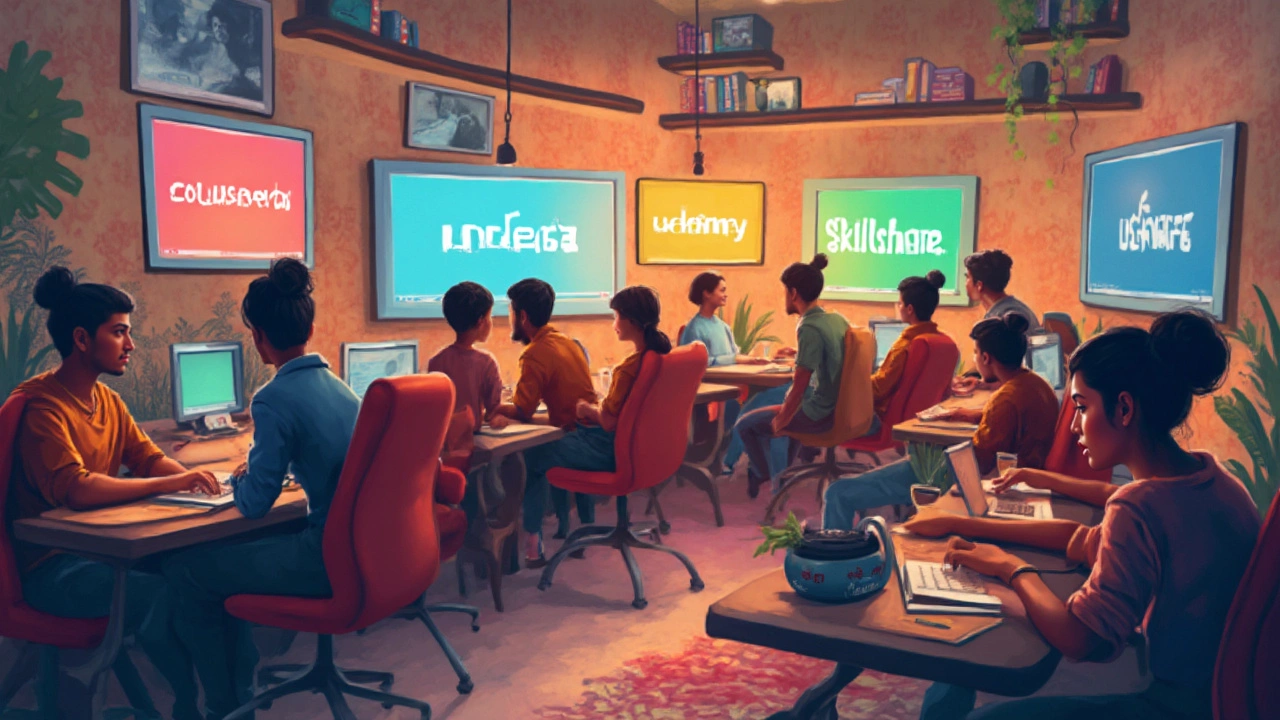
- Join MOOCs with credit pathways - Platforms like FutureLearn and edX partner with universities to let you earn transferable credits for a small fee. You can complete a full degree by combining free courses with paid credits.
Who benefits most from free online degrees?
Free degrees aren’t for everyone. They’re designed for people who:
- Live in countries with no affordable higher education
- Work full-time and can’t afford to quit for school
- Are self-disciplined and motivated without external pressure
- Need a credential to get past HR filters, not necessarily prestige
They’re not ideal for students who need campus life, lab access, internships, or face-to-face mentorship. If you’re aiming for medicine, engineering, or architecture, you’ll still need in-person training. But for IT, business, education, or social sciences? A free online degree can open doors.
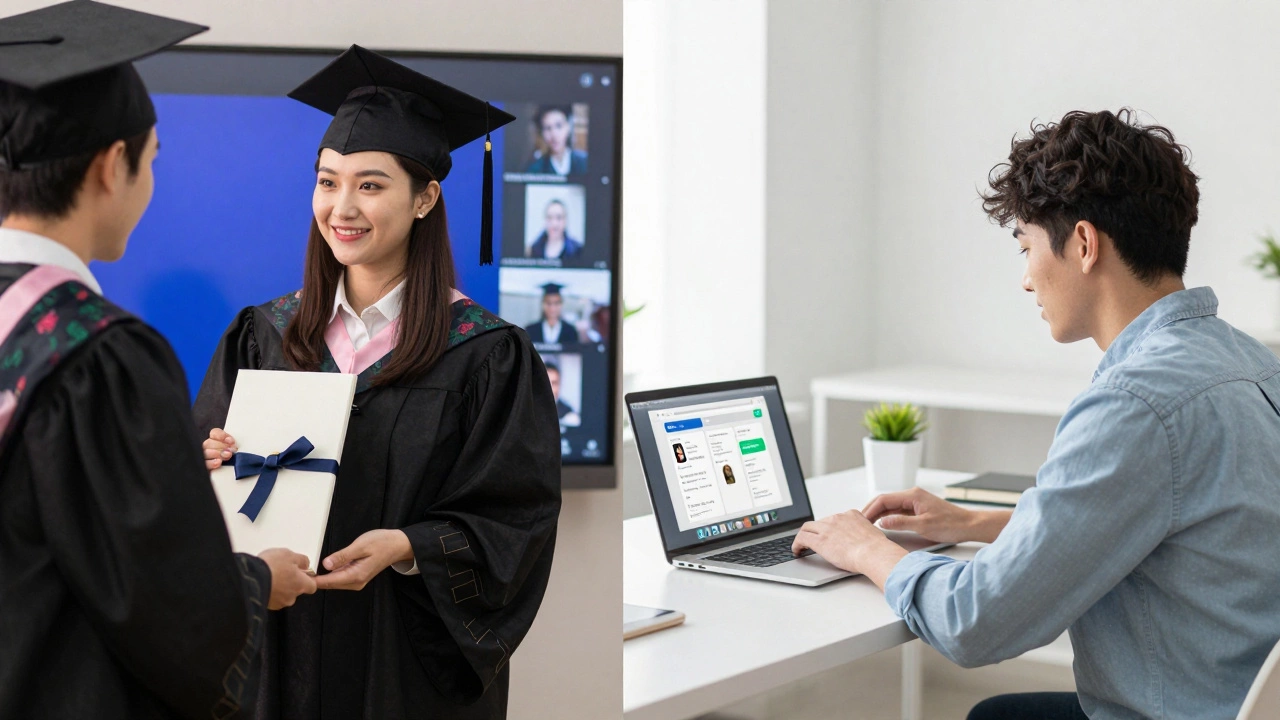
Real success stories
Anna, 32, from Birmingham, worked as a retail manager while raising two kids. She couldn’t afford tuition, so she enrolled in UoPeople’s Business Administration program. She studied after bedtime, using her phone during lunch breaks. Three years later, she graduated. She used her degree to get promoted to operations coordinator-now earning 40% more.
Marcus, 28, from Nigeria, took Computer Science courses through UoPeople while working as a tech support agent. He built a portfolio of small apps using free tools. After graduation, he landed a remote job with a U.S.-based startup. He now earns in dollars, not naira.
These aren’t outliers. UoPeople has graduated over 100,000 students since 2014. Most are working adults, single parents, or people from low-income countries. They didn’t get rich overnight. But they got a real credential-without debt.
What’s the catch?
There’s always a catch. Free online degrees require:
- Self-motivation - No one will remind you to turn in your paper.
- Reliable internet - You need stable access to upload assignments and take exams.
- Time management - Most programs expect 15-20 hours per week.
- Patience - It takes 3-5 years to finish a degree part-time.
And yes, some employers still prefer traditional degrees. But that’s changing. LinkedIn data from 2024 shows that 68% of hiring managers now consider online degrees from accredited institutions as equally valid as on-campus ones.
Next steps: How to get started today
If you’re serious about a free online degree, here’s your action plan:
- Decide what field you want to study (Business, IT, Education, etc.).
- Visit University of the People and apply for admission. No application fee.
- Fill out the financial aid form if you can’t afford the $120 assessment fee.
- Start with one course. Don’t try to do everything at once.
- Use free resources like Khan Academy, MIT OpenCourseWare, and YouTube to supplement your learning.
- Build a portfolio of projects-even small ones-to show what you’ve learned.
You don’t need money to start learning. You just need to begin.
Can I get a free online degree that’s recognized by employers?
Yes, but only from accredited institutions like University of the People or public universities in Germany. Degrees from unaccredited websites are not recognized and can hurt your job prospects. Always check accreditation before enrolling.
Are free online degrees really free, or are there hidden costs?
Most free degrees have small fees for assessments, exams, or graduation. University of the People charges $120 per course, but financial aid is available. You’ll also need to pay for textbooks, internet, and a computer-just like any student. But you won’t pay tuition.
Can I get a free online degree in the UK?
There are no fully free online degrees offered by UK universities for international students. The Open University offers free course materials but charges for degrees. Your best option is to apply to free programs in the U.S. or Germany.
How long does it take to complete a free online degree?
Most bachelor’s degrees take 3 to 5 years when studied part-time. Since you’re not on a traditional campus schedule, you control your pace. Some students finish faster by taking more courses per term, but most balance work and family, so 4 years is typical.
Do I need to take standardized tests like SAT or GRE for free online degrees?
No. University of the People doesn’t require SAT, ACT, or GRE scores. They review your high school diploma or equivalent, and sometimes ask for a short personal statement. This makes them accessible to people who didn’t follow traditional education paths.
Can I transfer credits from a free online degree to a traditional university?
Possibly. Many universities accept transfer credits from accredited online institutions like UoPeople, but it depends on the school and program. Always check with the receiving institution before starting your degree. Some may only accept credits from specific programs.